SMEs Achieve Amazon-Level Personalisation with AI
AI, E-commerce, Personalisation, SMEs
How SMEs Are Now Delivering Amazon-Level Hyper-Personalisation Without Amazon's Budget
AI personalisation for small business has quietly crossed a tipping point. What used to demand Amazon-sized data teams and Netflix-level budgets is now achievable by a 10–50 person company with smart tools, clear goals, and a 90-day plan. This guide shows you how to get there.

What Hyper-Personalisation Really Means (Beyond First Name Tokens)
Hyper-personalisation is not “Hi <First Name>” in an email. That’s table stakes. True hyper-personalisation means every touchpoint adapts in real time to who your customer is, what they’re doing right now, and what they’re likely to need next.
In practice, that looks like:
- A visitor who browsed running shoes yesterday seeing fresh, in-stock trainers and sizing advice the moment they land today.
- An email that changes its product blocks based on what the subscriber clicked 10 minutes ago, not last month.
- Ads that stop following people with products they already bought and instead promote the logical next step in their journey.
Hyper-personalisation uses AI to combine behavioural data (clicks, scrolls, purchases), context (device, time, location), and predictions (likelihood to buy, churn, or upgrade) to treat each person as a “segment of one”. It’s dynamic, predictive, and always-on — and that’s where the conversion uplift comes from.
How Amazon and Netflix Built Personalisation at Scale — And Why SMEs Were Locked Out
Amazon and Netflix set the gold standard for personalisation. For years, their advantage came from three things most SMEs simply didn’t have:
- Massive data volume: Billions of interactions to train recommendation models and test tiny improvements at scale.
- Specialist teams: In-house data scientists, machine learning engineers and experimentation squads building custom engines for product discovery and content ranking.
- Infrastructure budgets: Multi-million-dollar investments in data lakes, real-time processing, and experimentation platforms.
Until recently, replicating even a fraction of that was unrealistic for a company with 10–50 employees. Custom models, engineers on six-figure salaries, and complex cloud setups were out of reach. So most SMEs settled for static “people also bought” widgets and basic email segments based on last purchase date.
The shift in 2025–2026 is that the same kind of intelligence is now packaged into off-the-shelf AI personalisation platforms. Tools like Unless, Personizely, HYPERISE, ChatDaddy, Insider and HubSpot AI give you:
- Pre-trained recommendation and segmentation models
- Visual editors to personalise pages and emails without coding
- Integrations with Shopify, WooCommerce, CRMs and ad platforms
Instead of hiring a data science team, you rent one “as a service” for a few hundred dollars a month — or even start on a free tier. That’s why AI personalisation for small business is suddenly not just possible, but practical.
Why Real-Time AI Personalisation Is Now a 30% Conversion Opportunity
Across e-commerce, SaaS and services, real-time AI personalisation is consistently driving double-digit gains. Benchmarks for 2025–2026 show behaviour-driven, predictive experiences can increase conversions by up to 30%, with SaaS activation and trial-to-paid lifts in the 18–34% range (Lean On Marketing, 2026 benchmarks for predictive personalisation).
In retail, Sentos Technologies reports a mid-market e-commerce client achieving a +28% conversion rate and +19% AOV after deploying a real-time ML personalisation engine, while Nike Chile saw around +30% sales per ticket and demand uplift with AI-driven journeys. These are not outliers any more — they’re what “good” looks like in 2026.
The Four Layers of AI Personalisation Every SME Can Use
1. Product Recommendations (and Service Suggestions)
This is the engine behind “Customers who bought this also liked…”, but smarter. Modern e-commerce personalisation AI looks at:
- What similar customers viewed, bought and returned
- Real-time behaviour in the current session
- Stock levels, margins and bundles you want to promote
Tools like Hello Retail, Unless, Ustyle, and Agentmelt are proving that even smaller brands can see 17–33% revenue and AOV lifts from smarter recommendations alone.
2. Email Personalisation
AI-enhanced email platforms such as Klaviyo, HubSpot AI and Attentive now personalise:
- Send times (per subscriber, based on when they usually open)
- Subject lines and CTAs (optimised via AI copy testing)
- Dynamic content blocks that swap products, stories, or offers based on behaviour
Instead of one generic newsletter, you send thousands of micro-variations — automatically. That’s hyper-personalisation SME teams can manage in a few clicks.
3. Ad Targeting and Creative
Real-time AI personalisation also powers smarter ad campaigns. Platforms like Meta Ads, Google, and programmatic tools now allow:
- Dynamic product ads tailored to browsing or cart behaviour
- Audiences built from predicted high-LTV or high-churn cohorts
- Creative variants that auto-optimise to the best-performing messaging per segment
For a small business, this means fewer wasted impressions and more budget going to the people most likely to convert — without micro-managing every ad set.
4. Website and Journey Personalisation
Website personalisation platforms like Unless, Personizely, Mutiny and Insider let you turn a static site into a living, adaptive experience. You can:
- Swap headlines and hero images by visitor segment (new vs returning, industry, location)
- Change CTAs based on funnel stage (book demo vs start trial vs download guide)
- Trigger AI chat or guided wizards when a user looks stuck or high-intent
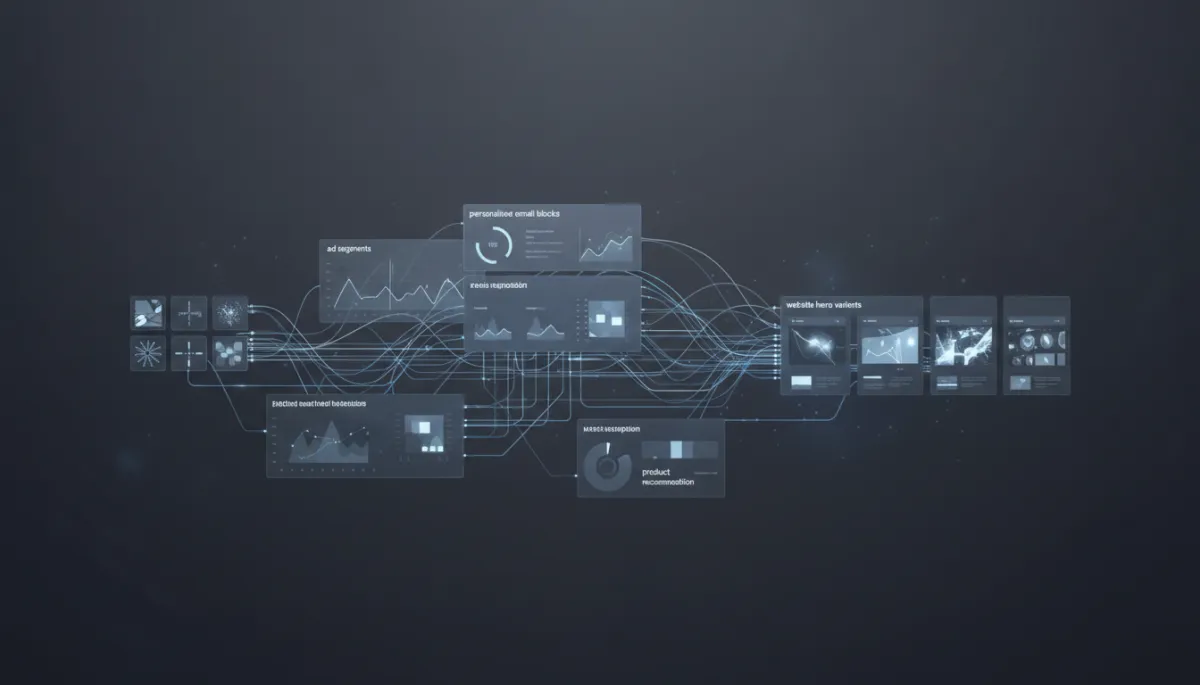
Coordinated AI personalisation across site, email, and ads multiplies impact for SMEs.
A Practical 90-Day Playbook for SMEs Under 50 Employees
Step 1: Clarify One North-Star Metric (Week 1)
Start simple. Pick the metric AI personalisation should move first: conversion rate, AOV, repeat purchase rate, or lead-to-opportunity rate. This keeps your tools, tests and dashboards focused, instead of chasing vanity metrics.
Step 2: Choose Lightweight Tools That Meet You Where You Are (Weeks 1–2)
For most SMEs, the winning move is to plug AI into systems you already use:
- E-commerce: Start with Unless, Personizely, HYPERISE or ChatDaddy for on-site personalisation and product recommendations. Pair with Klaviyo or HubSpot AI for email and lifecycle flows. Many offer free or low-cost tiers around $19/month.
- Services & B2B: Use HubSpot AI or similar CRM tools for lead scoring, content personalisation and journey triggers. Add Mutiny or Insider when you’re ready to personalise key landing pages at scale.
Step 3: Implement One Use Case Per Channel (Weeks 2–6)
Don’t try to “AI everything” at once. For a team under 50 people, momentum matters more than perfection. Aim for:
- Website: Personalised homepage hero for new vs returning visitors.
- Recommendations: “Frequently bought together” and “You might also like” blocks powered by AI, not static rules.
- Email: Abandoned cart and browse recovery flows with dynamic product content and AI-optimised subject lines.
Step 4: Connect the Dots and Scale What Works (Weeks 6–12)
Once the first wins are clear, start linking data between tools — web behaviour to email, email engagement to ad audiences, purchase history to recommendations. Many SMEs now run stacks of around five AI tools, according to 2026 SMB benchmarks, but the top performers are those that integrate them into coherent workflows, not isolated experiments.
Real-World AI Personalisation Journeys: E-commerce, Healthcare, Real Estate
E-commerce: From Static Catalogues to Smart Storefronts
Small and mid-sized retailers are already using e-commerce personalisation AI to punch far above their weight:
- BOBO Home used Hello Retail to personalise category pages instead of showing only bestsellers. Result: +17% revenue per visitor across Scandinavia.
- Mialuis, a small leather brand, added Ustyle’s AI styling widget. In just 60 days, it contributed 33% of total revenue.
- A DTC skincare brand using an AI ecommerce agent via Agentmelt saw a 22% increase in AOV and 35% uplift in repeat purchases.
None of these brands are Amazon. They’re proof that with the right AI personalisation for small business, you can turn a modest catalogue into a curated experience that feels hand-picked for every shopper.
Healthcare: Personalised Outreach That Improves Lives and Revenue
In healthcare, Deloitte helped a major U.S. organisation build an AI personalisation platform that clustered under-engaged patients and used reinforcement learning to pick the right channel and timing for outreach. The result: improved medication adherence, better care coordination, and over $100 million in revenue generated while reaching around 10% of the patient base with personalised journeys.
The same principles apply to smaller clinics and health providers: use AI to understand who is at risk of dropping out, what message resonates, and which channel (SMS, email, phone) they’re most likely to respond to — then automate the follow-up.
Real Estate: Turning Anonymous Browsers into Qualified, Nurtured Leads
Real estate has quietly become a playground for hyper-personalisation SME strategies:
- Univisia built an AI WhatsApp assistant that lets buyers describe their ideal property in natural language and receive tailored listings in seconds, now serving around 15 agencies.
- YUKTAAI deployed conversational AI that qualifies intent, schedules visits, and follows up automatically. Clients saw 3.8× more qualified leads and 41% more site visit bookings, with response times dropping from 14 hours to under 90 seconds.
For a small brokerage, this is game-changing. AI personalisation doesn’t just recommend properties; it orchestrates a tailored journey from first click to signed contract.
Your Next Step: Turn Curiosity into a Concrete Personalisation Plan
The gap between your business and Amazon-level experiences is no longer about budget — it’s about clarity and execution. With today’s tools, a focused SME can:
- Launch meaningful AI-driven personalisation in under 90 days
- See 15–30% lifts in key metrics when journeys are well-designed
- Build compounding advantage as models learn from your unique customers
If you’re ready to move from inspiration to implementation — and want a clear view of where personalisation will have the biggest payoff on your site — start with your foundation: search visibility, content, and user experience.
Get a Free SEO and Website Audit at nexurate.com and uncover exactly where AI personalisation can plug into your current journeys, which tools fit your stage, and how to turn your website into a living, learning asset that grows revenue month after month.
