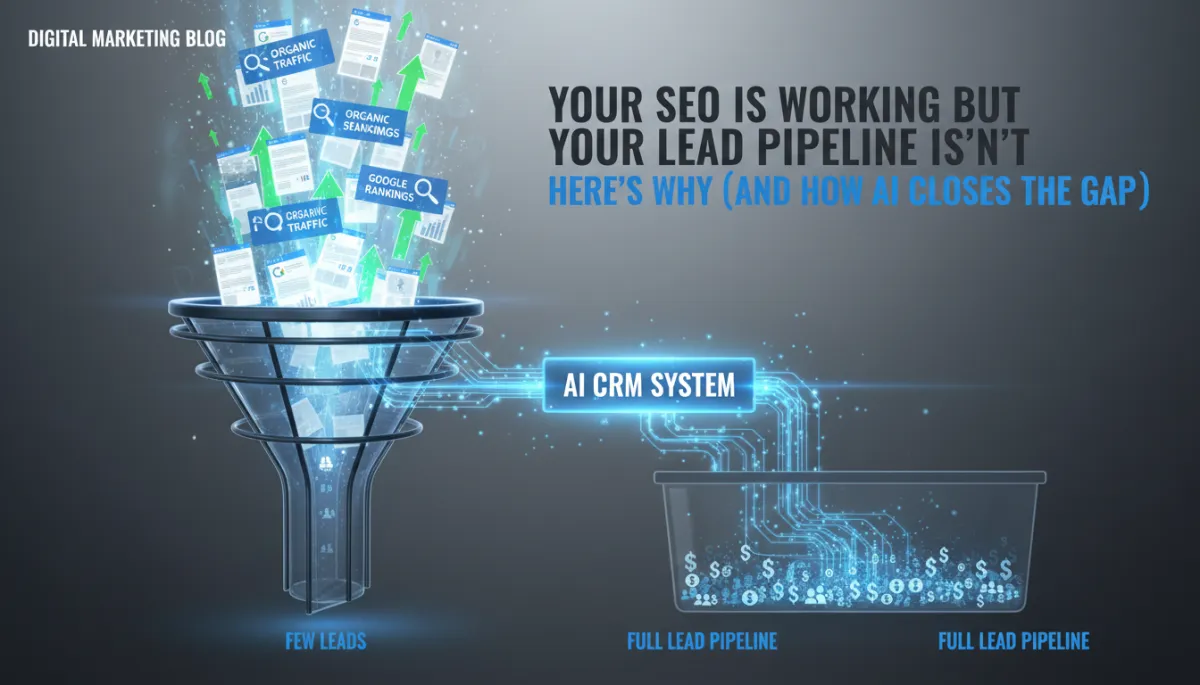
Your SEO Is Working But Your Lead Pipeline Isn’t — Here’s Why (And How AI Closes the Gap)
Your SEO investment is paying off. Your blog posts are ranking. Your website traffic is climbing. Google is sending you qualified visitors every single day.
And yet your lead pipeline is empty. Enquiries are not coming in. Sales calls are not being booked. Revenue from organic traffic is not materialising. You wonder whether SEO is actually working — or whether you are just getting more visitors who do nothing.
The problem is not your SEO. The problem is the gap between your organic traffic and a functioning lead capture and conversion system. And AI closes that gap. Here is exactly why it exists and what to do about it.
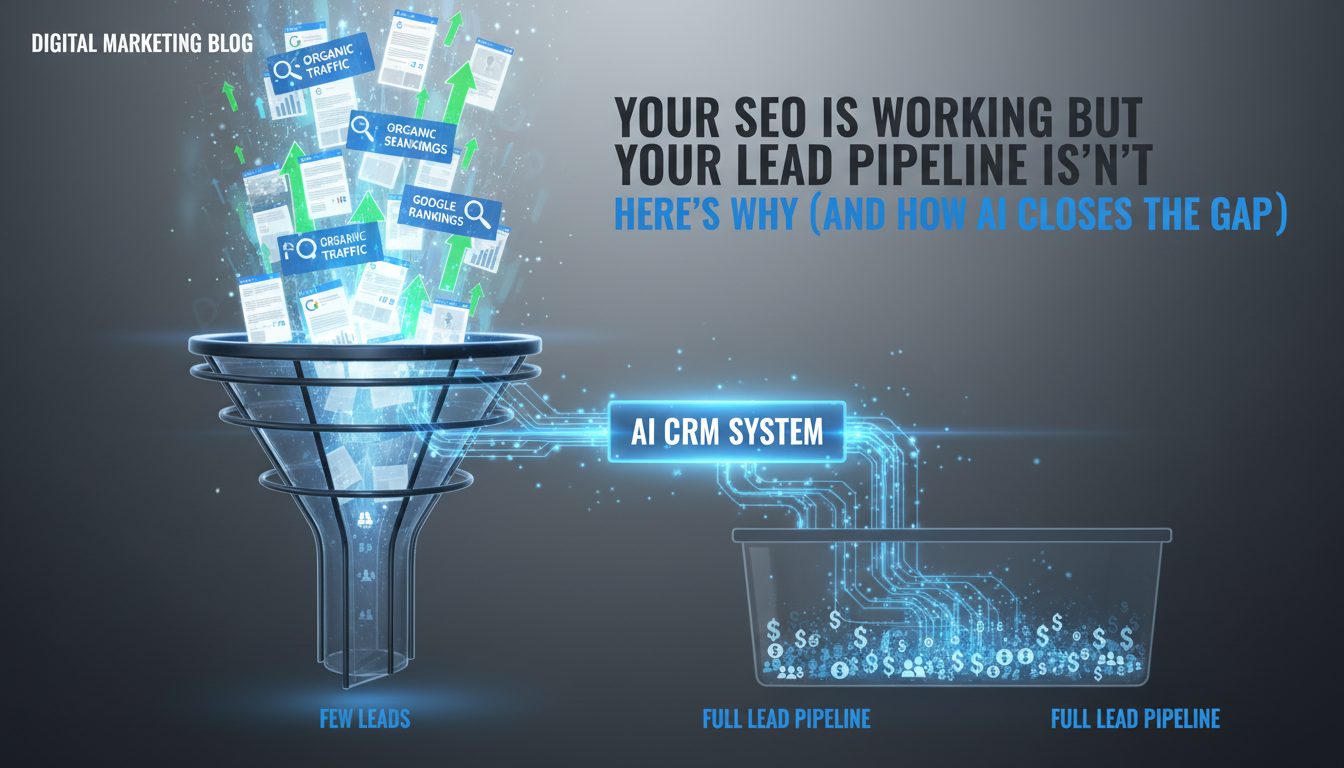
Why Does SEO Traffic Fail to Generate Leads for SME Websites?
Because SEO drives traffic — but it does not convert traffic. Conversion requires a separate system that most SME websites do not have.
SEO gets a visitor to your website. But once they arrive, the average SME website offers them three options: fill out a contact form (which feels like work), call a phone number (which requires commitment), or leave. And 80% of them choose to leave.
This is the fundamental gap. SEO is a top-of-funnel tool. It attracts interested people. But without a capture layer, a nurture system, and a follow-up mechanism, that interest evaporates before it ever becomes a lead in your CRM. And no amount of additional SEO spend will fix a conversion problem.
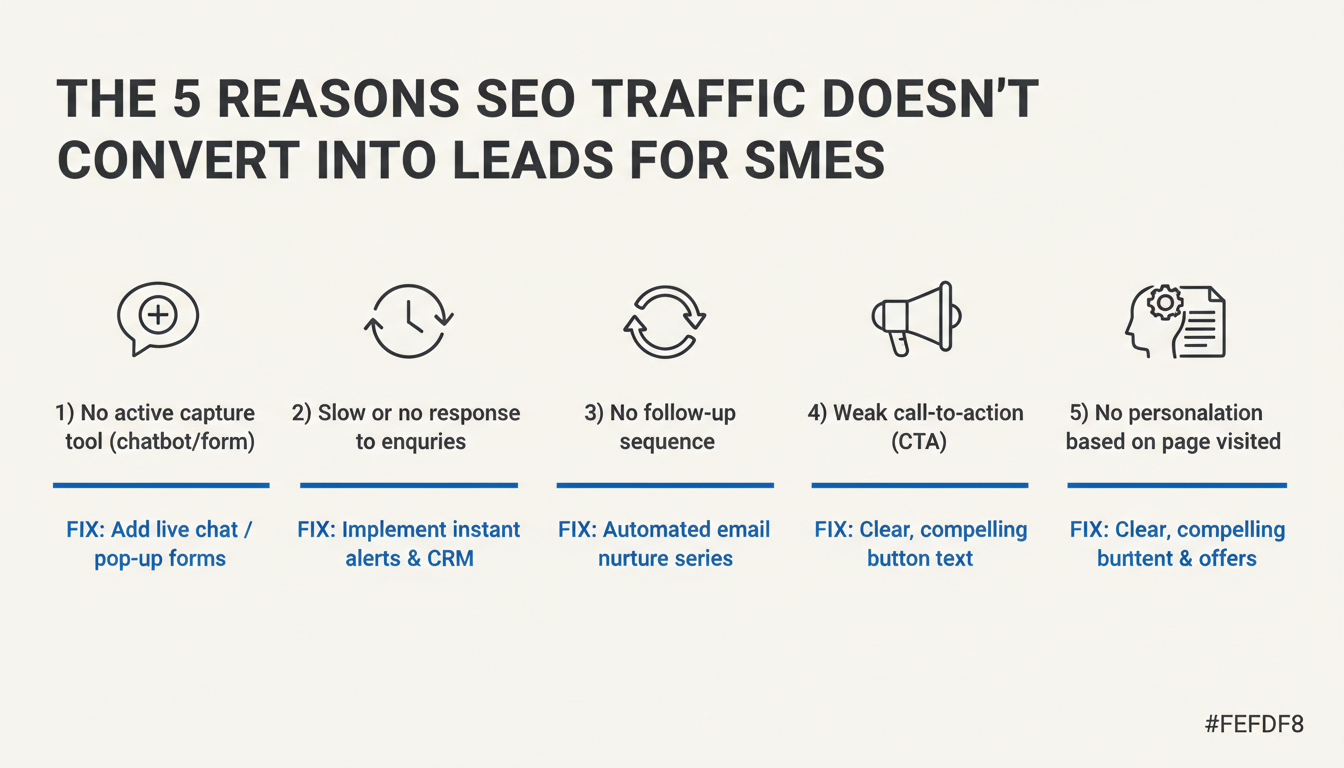
The 5 Specific Reasons Your SEO Traffic Is Not Converting
Understanding why your organic traffic is not converting into leads is the first step to fixing it. These five issues account for 90% of the gap between strong SEO rankings and weak lead pipelines.
1. No proactive engagement tool: Your website waits for visitors to reach out. An AI chatbot or WhatsApp widget proactively engages visitors based on the page they are on, the time they have spent, and the actions they have taken. Passive websites lose. Proactive ones convert.
2. Generic CTAs that do not match search intent: A visitor who found your website by searching “AI CRM for healthcare clinics” and lands on your homepage to see “Contact Us” as the only CTA is not going to convert. The CTA must match what they were looking for. AI personalisation tools can serve different CTAs based on the page entered and the search term used.
3. No follow-up for partial engagements: A visitor who spends 4 minutes on your pricing page but does not submit a form is a warm lead. Most websites have no mechanism to capture this engagement and follow up. An AI CRM with behavioural tracking turns this anonymous interest into a named, followable prospect.
4. Too slow to respond to enquiries that do come in: Even when an enquiry does arrive from organic traffic, slow response kills the conversion. A visitor who found you organically was probably also looking at two or three competitor websites. First to respond wins.
5. No nurture sequence for high-consideration purchases: If your service requires a high consideration decision, a single website visit is rarely enough. Without an automated nurture sequence that educates, builds trust, and follows up over days or weeks, most organic leads will convert somewhere else.
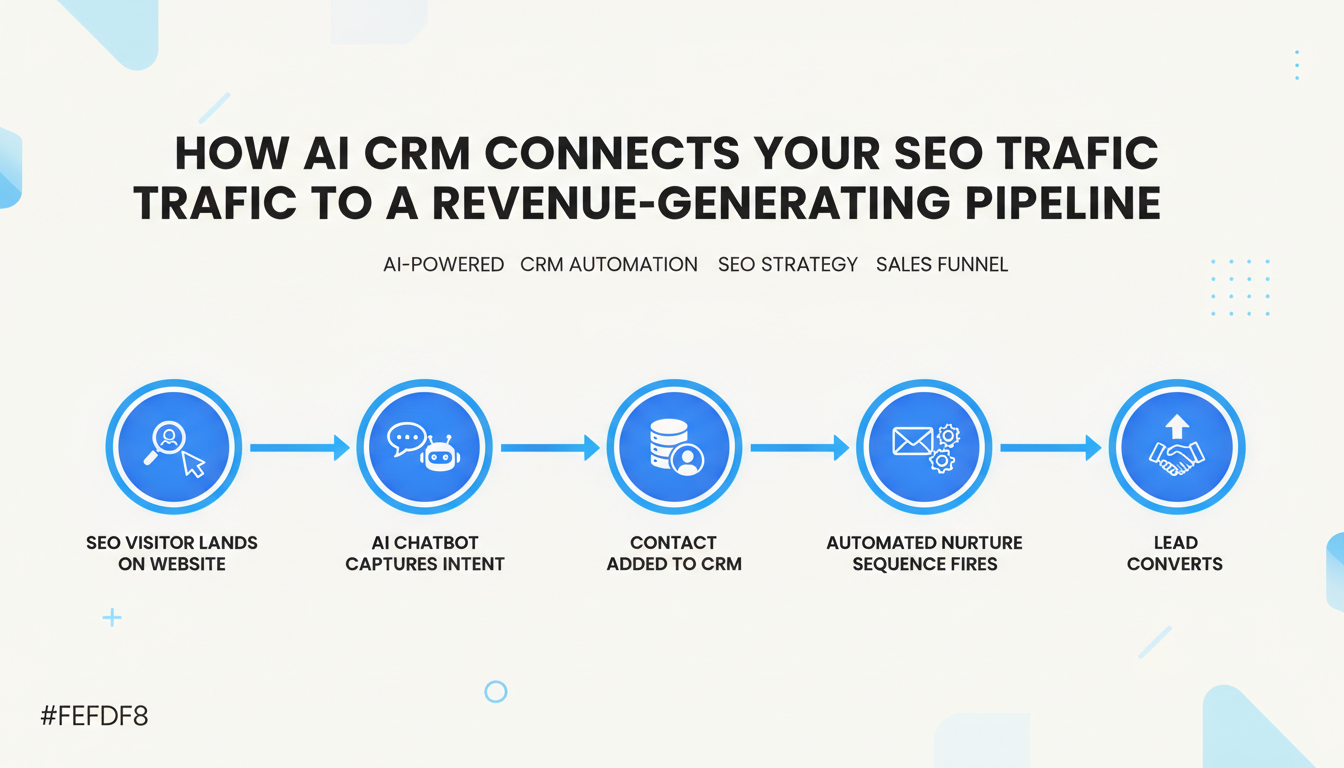
What the AI Layer That Connects SEO to Revenue Looks Like
The AI layer is a set of tools and automations that sit between your SEO traffic and your sales pipeline — capturing intent, nurturing interest, and converting organic visitors into qualified leads automatically.
Here is what a complete AI conversion layer looks like for an SME website:
- AI Chat Widget: Proactively engages visitors based on the page they are browsing. A visitor on your AI CRM services page gets: “Looking for CRM solutions for your business? I can recommend the right package in 2 minutes.”
- WhatsApp Click-to-Chat: A floating button with a pre-filled message removes all friction from reaching out. Especially effective for mobile organic traffic, which now represents over 60% of SME website visits.
- Behavioural Lead Capture: Visitors who spend time on high-intent pages (pricing, services, case studies) are tracked by the CRM. If they do not convert during the visit, an exit-intent offer fires. If they have previously provided their details, the CRM logs the intent signal and increases their lead score.
- Instant Response Automation: When an organic visitor does submit a form or WhatsApp message, an automated response fires within 30 seconds. By the time they check their messages, you have already acknowledged them and provided next steps.
- SEO-Aligned Nurture Sequences: For high-consideration services, an automated email and WhatsApp nurture sequence delivers relevant content based on which page the visitor originally came from — keeping your business top of mind until they are ready to buy.
What the Numbers Look Like When You Add AI to Existing SEO
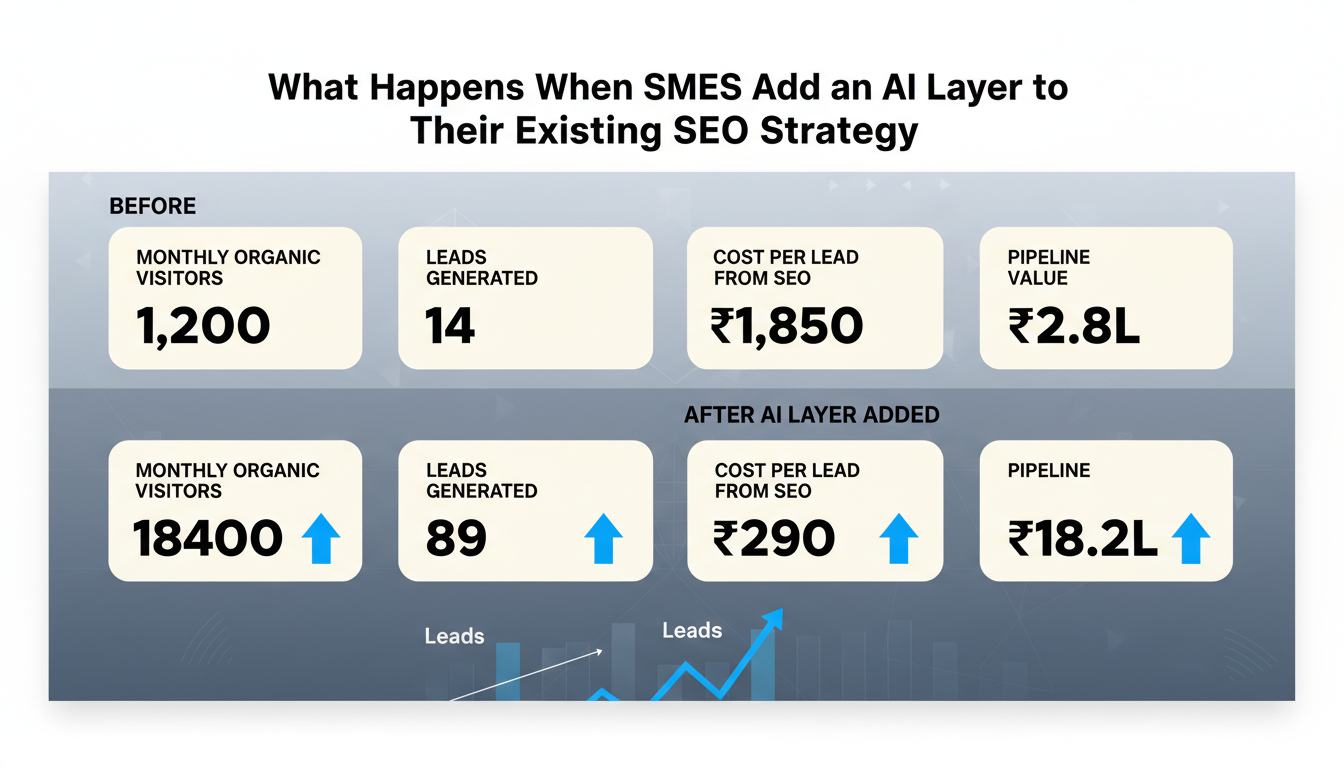
Adding an AI conversion layer to an existing SEO strategy typically increases monthly leads from organic traffic by 300–600% — without changing a single piece of SEO content.
Consider this real-world scenario: an SME website receiving 1,200 organic visitors per month with a 1.2% conversion rate generates approximately 14 leads. After deploying AI chat, WhatsApp integration, behavioural capture, and a 5-touch nurture sequence, the same 1,200 visitors convert at 7.4% — generating 89 leads. Same traffic. Same rankings. Six times more leads. The only change: the AI layer between the traffic and the sales pipeline.
How to Audit Your Own SEO-to-Pipeline Gap
The gap between your organic traffic and your pipeline is measurable — and the audit takes less than 30 minutes.
Step 1: Check your monthly organic visitor count (Google Search Console or Analytics). Step 2: Check your monthly enquiry count from organic sources (your CRM or contact form logs). Step 3: Divide enquiries by visitors to get your current organic conversion rate. Step 4: If that rate is below 3%, you have a significant gap — and an AI conversion layer is the fastest, most cost-effective way to close it.
Most SMEs who run this audit discover they are converting at 0.5–2% from organic traffic. The industry benchmark for well-optimised websites with active AI capture tools is 6–12%. The gap represents real revenue sitting uncaptured in your existing traffic.
Frequently Asked Questions: SEO, AI, and Lead Pipeline
If I add an AI capture layer, do I still need to invest in SEO?
Yes. SEO and AI are complementary, not alternative. SEO drives the traffic. AI converts it. One without the other leaves significant value on the table. The most effective digital growth strategy in 2026 runs both simultaneously.
Does adding an AI chatbot affect my SEO rankings?
No. A properly implemented AI chat widget does not affect your page speed or Core Web Vitals scores, and has no negative impact on your search rankings.
How quickly can I set up an AI conversion layer?
A basic AI chat widget and WhatsApp button can be live within hours. The full conversion layer — including behavioural capture, instant response, and nurture sequences — typically takes 24–48 hours to configure properly.
What if my organic traffic is very low — will AI capture tools still help?
Yes. Even at 200–300 visitors per month, improving conversion from 1% to 8% means the difference between 2 and 24 leads per month. At low traffic volumes, conversion optimisation delivers proportionally higher impact than additional traffic generation.
Your SEO Is Not the Problem. Your Capture Layer Is.
Every organic visitor who lands on your website and leaves without contacting you represents money you spent on SEO that did not return. The investment has already been made. The traffic is already there. Adding the AI conversion layer is the fastest possible route to turning your existing SEO investment into actual revenue — and it starts working from day one.
Ready to find out exactly how much revenue your current SEO traffic is leaving on the table? Get a Free SEO / Website Audit from Nexurate Technologies — and walk away with a precise roadmap to converting your organic traffic into a pipeline that delivers.
