
Predictive Lead Scoring with AI for Indian SMEs
Sales, Predictive Lead Scoring, AI CRM, Indian SMEs
Predictive Lead Scoring: How AI Tells You Which Leads Will Buy Before You Even Call Them
Your sales team just spent three hours calling 20 leads. Seventeen will never buy. Only three were genuinely ready to talk pricing, timelines, and next steps. Predictive lead scoring for small business flips this equation: it uses AI to tell you which three are ready to buy before you dial, so your team stops burning time on cold prospects. In this guide, you’ll see what predictive lead scoring is, why Indian SMEs are losing up to 70% of sales time on the wrong leads, how AI scoring actually works, the real results it delivers, and how to set it up inside Nexurate CRM for your own pipeline.
What Is Predictive Lead Scoring?
Predictive lead scoring is a data-driven way to rank your leads based on how likely they are to become paying customers. Instead of your team guessing who looks “promising”, AI analyses past deals, current behaviour, and dozens of subtle signals to assign every lead a score. High scores mean “call now”, mid-range scores mean “nurture”, and low scores mean “don’t waste your best salesperson’s time”.
How it differs from manual lead qualification
Manual qualification is slow, subjective, and inconsistent. One sales rep might prioritise job title; another might chase anyone who asks for a brochure. Spreadsheets get messy, notes are incomplete, and “gut feel” dominates. Even the best reps can only track a handful of signals in their head at once.
Predictive lead scoring replaces this guesswork with lead qualification automation. The system learns from your historical wins and losses, then applies that learning to every new lead in real time. Global benchmarks show that AI-driven models often outperform traditional point-based systems by a wide margin, with the top AI-scored quartile of leads converting dramatically better than the rest. Instead of debating which lead to call, your team simply works the top of a ranked list inside your CRM.
What data signals AI uses to score leads
Modern AI lead scoring India solutions combine four main categories of signals:
Demographic & firmographic fit: industry, company size, location (Metro vs Tier-2 city), job role, decision-making power, revenue band, and whether they match your ideal customer profile for Indian SMEs.
Behavioural signals: pages visited on your website (especially pricing or case studies), time spent on site, form submissions, demo requests, and downloads of brochures or proposals.
Engagement signals: email opens and clicks, WhatsApp replies, call outcomes, webinar attendance, and how quickly they respond when your team reaches out. In India, WhatsApp engagement is particularly powerful, with open rates far higher than email, so it’s a critical input to any scoring model.
Negative & decay signals: long periods of no response, bounced emails, unsubscribes, or repeated no-shows for meetings. These tell the AI to lower the score so reps stop chasing dead leads.
Together, these signals feed into a single score that your team can see directly inside Nexurate CRM, turning raw data into clear CRM lead prioritization.
Why Indian SMEs Are Wasting 70% of Their Sales Time on Wrong Leads
The hidden cost of unqualified follow-up
Most Indian SMEs have a top-of-funnel problem and a focus problem. Marketing agencies, performance campaigns, and marketplaces send dozens or hundreds of leads every week. But if your team treats every enquiry as equal, you end up spending 70% of your time chasing people who only wanted a price check or free consultation. The visible cost is salaries; the hidden cost is opportunity — the hot leads that slip away because your best reps were stuck on follow-up calls that never had a chance.
Research on AI-led scoring shows that once teams adopt predictive models for at least 90 days, qualified-lead conversions can jump more than 2x, largely because reps stop wasting time on low-intent prospects and refocus on the top-scoring segment. That is exactly what predictive lead scoring for small business is designed to do: cut out the noise so every hour of calling is focused on the 20–30% most likely to move forward.
How traditional lead management creates pipeline chaos
Traditional lead management in Indian SMEs usually looks like this: leads land in a shared inbox or spreadsheet, someone manually assigns them, and every rep follows their own system of colour codes, notes, and reminders. There is no single source of truth, and no agreement on what a “hot” lead really means. As your volume grows, this quickly turns into pipeline chaos: duplicate follow-ups, missed callbacks, and zero visibility into which campaigns actually bring in buyers.
💡 Pro Tip: If you can’t clearly answer “Which 50 leads should my team call today?” you don’t have a scoring system — you have a list.
An AI-powered AI sales pipeline changes this. Every new enquiry is automatically scored and slotted into a clear priority band. Reps see an ordered list, managers see conversion rates by score band, and leadership finally sees which sources and campaigns deliver truly sales-ready leads, not just clicks and form fills.
How AI Predictive Lead Scoring Works in Practice
Step 1 — Data collection (CRM history, website behaviour, email engagement)
The process starts with the data you already have. Nexurate CRM pulls in:
Past deals — who bought, what they bought, deal size, and sales cycle length.
Website behaviour — pages visited, forms submitted, time on site, repeat visits.
Email and WhatsApp engagement — opens, clicks, replies, and link visits.
Call outcomes — connected/not connected, interested, budget issues, timeline, and follow-up commitments.
Clean, centralised data is the foundation. The better your CRM hygiene, the more accurate your predictive model becomes — and the more time your reps win back.
Step 2 — Pattern recognition (which past customers share which traits)
Next, the AI looks for patterns. It asks questions like:
Which industries and company sizes closed fastest and at the highest value?
What behaviours did buyers show before signing — for example, revisiting the pricing page three times, or replying to a WhatsApp message within 10 minutes?
Which signals usually predicted a “no” — such as never opening emails, repeatedly rescheduling calls, or only asking for discounts?
Globally, these models can reach 78–88% accuracy in predicting conversion when fed with enough quality data. For Indian SMEs, even a modest improvement in accuracy can mean a huge jump in revenue, because sales capacity is limited and every wasted call hurts.
Step 3 — Score assignment and real-time prioritisation
Once patterns are learned, the AI assigns every lead a score — often on a 0–100 scale or in tiers like A/B/C. This happens continuously. When a lead opens an email, visits your website again, or replies on WhatsApp, their score updates automatically. This is the heart of CRM lead prioritization: your team doesn’t need to recalculate anything; they simply work from the highest scores down.
Step 4 — Automated routing — hot leads to sales, warm leads to nurture
Finally, automation takes over. With Nexurate’s workflows, you can define rules such as:
Leads scoring above 80 are instantly assigned to senior sales reps, with a task to call within 15 minutes.
Leads between 50–79 enter an automated lead nurturing sequence via email and WhatsApp, educating them and warming them up until they are ready to talk.
Leads below 50 receive light-touch follow-up only, so your team doesn’t burn hours on low-intent prospects.
This is where lead qualification automation pays off: your AI sales pipeline is always sorted, and your best people are always talking to your best prospects.
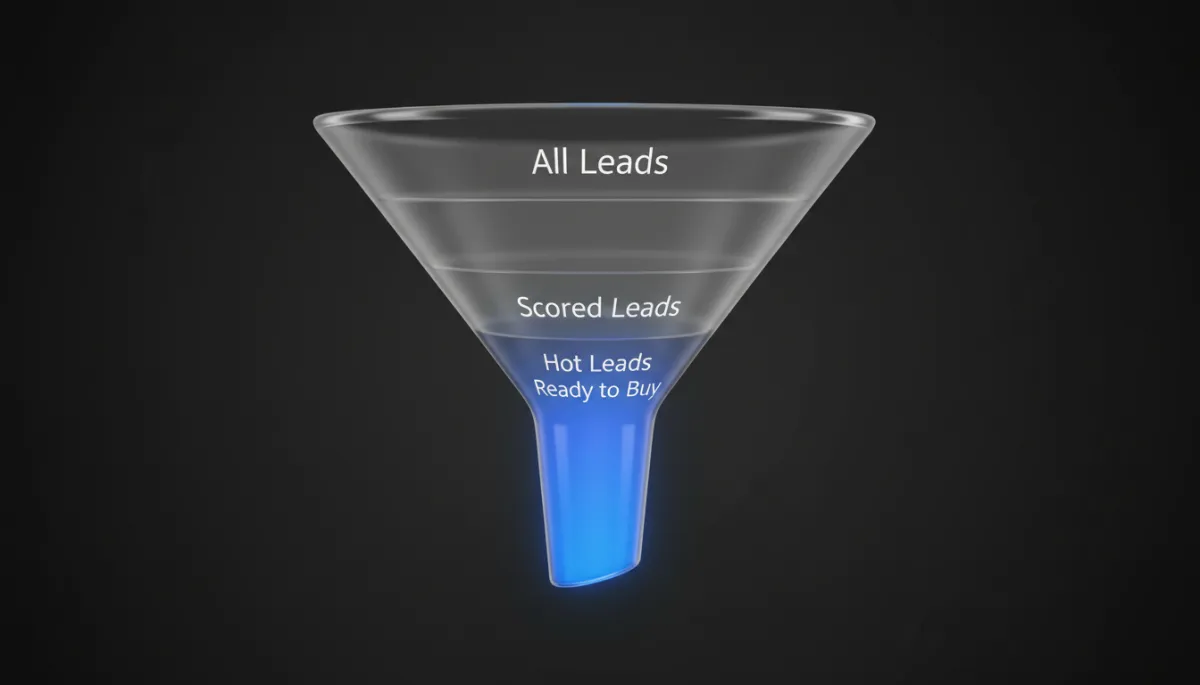
AI filters noisy top-of-funnel enquiries into a focused list of hot, sales-ready leads.
Real Results — What Happens When You Score Leads with AI
Predictive scoring is not a theory — it delivers measurable outcomes. One Indian digital agency using Nexurate CRM implemented automated lead nurturing and AI-based scoring across their inbound enquiries. Within just three months, they saw a 35% increase in lead conversions. The agency didn’t increase ad spend or headcount; they simply focused their existing team on the right leads at the right time.
This kind of uplift is consistent with broader industry research, where businesses adopting AI scoring and automation often report 20–35% higher conversion rates and significantly more qualified opportunities from the same lead volume. The biggest win is not just more deals — it’s the clarity. Sales meetings become more predictable, follow-up becomes more disciplined, and your marketing team finally gets feedback on which campaigns attract high-scoring, high-value customers.

Moving from manual sorting to AI-ranked lists transforms sales from chaos into controlled growth.
How to Implement Predictive Lead Scoring with Nexurate CRM
You don’t need a data science team to get started. Here’s a practical, step-by-step way to implement predictive lead scoring for small business using Nexurate CRM.
Connect all your lead sources. Integrate your web forms, ad platforms, WhatsApp, and email into Nexurate so every enquiry lands in one place. This eliminates duplicate records and gives the AI a complete view of each lead’s journey.
Define what a “good” lead looks like. With your sales team, list the characteristics of your best customers: industries, locations, deal sizes, decision-makers, and typical buying signals. This helps configure the initial scoring framework and ensures your reps trust the scores they see.
Turn on Nexurate’s predictive scoring module. Nexurate’s AI will analyse your historical CRM data to learn which traits and behaviours correlate with closed deals. It then starts assigning scores to existing and new leads automatically, updating them as behaviour changes.
Build smart workflows for each score band. Use Nexurate’s CRM automation services to route leads based on their score. For example, create workflows that:
– Instantly assign high-scoring leads to senior reps with call tasks and reminders.
– Drop mid-scoring leads into educational lead nurturing sequences with case studies and testimonials.
– Park low-scoring leads into a long-term newsletter or drip campaign without consuming daily calling capacity.Train your team to work the scores. Show your sales reps where to see the score inside Nexurate CRM, how to filter by hot leads, and how to interpret the top contributing factors (for example, “+15: visited pricing page”, “+10: replied on WhatsApp”). This transparency builds trust and adoption.
Monitor, refine, and scale. After 60–90 days, review your conversion rates by score band. Are A-leads closing at a much higher rate than C-leads? Which campaigns produce the most high-scoring leads? Use these insights to refine your scoring thresholds, adjust your ad spend, and further automate your AI sales pipeline.
📌 Key Takeaway: Predictive scoring only works if your team actually uses it. Keep the model explainable, keep the workflows simple, and make the “next best lead” obvious inside your CRM.
Ready to See Which Leads Will Buy Before You Call?
If your team is tired of chasing cold enquiries, it’s time to let AI do the heavy lifting. Predictive lead scoring for small business is no longer a luxury reserved for large enterprises — Indian SMEs are already using it to double their qualified pipeline and boost conversions without hiring more reps or spending more on ads.
Book a free Growth Strategy Session with the Nexurate team. We’ll plug your existing data into Nexurate CRM, set up predictive lead scoring for your pipeline, and help you identify your highest-probability leads immediately — so tomorrow’s three hours of calling are spent only on the prospects who are actually ready to buy.
