Online Reputation Management for Small Businesses: Get 5-Star Reviews on Autopilot in 2026
Before a single potential customer calls you, visits your website, or walks through your door, they have already Googled you. They have read your reviews. They have checked your star rating. And they have made a preliminary decision about whether to trust you based entirely on what other people say about your business online.
This is online reputation management — and for small businesses in 2026, it is not optional. It is the difference between a full appointment book and an empty one, between a phone that rings and one that is silent. The good news: it can be automated, and it can be built on autopilot. Here is how.
Why Does Your Google Rating Matter More Than You Think?
Your Google Business rating directly influences how many people click through to your website, how many call your number, and ultimately, how many become paying clients — regardless of your ad spend or SEO ranking.
The research on this is unambiguous: businesses with a 4.7–5.0 star rating receive up to 12 times more click-throughs from Google search results than businesses rated below 4.0. A business with 200 reviews and a 4.8 rating consistently outperforms a business with 10 reviews and a 5.0 rating, because volume of reviews signals trustworthiness at scale.
For small businesses, this creates a compounding problem. Without a systematic review collection process, most businesses accumulate reviews slowly and unevenly — often driven by dissatisfied customers (who are statistically more motivated to leave a review) rather than happy ones. The result: a rating that does not reflect the actual quality of your service, suppressing your visibility and conversion from organic search.
The Automated Review Request System That Changes Everything
The most effective review generation strategy for small businesses is a timed, automated review request sent via WhatsApp 48–72 hours after service delivery — when the client experience is fresh and satisfaction is highest.
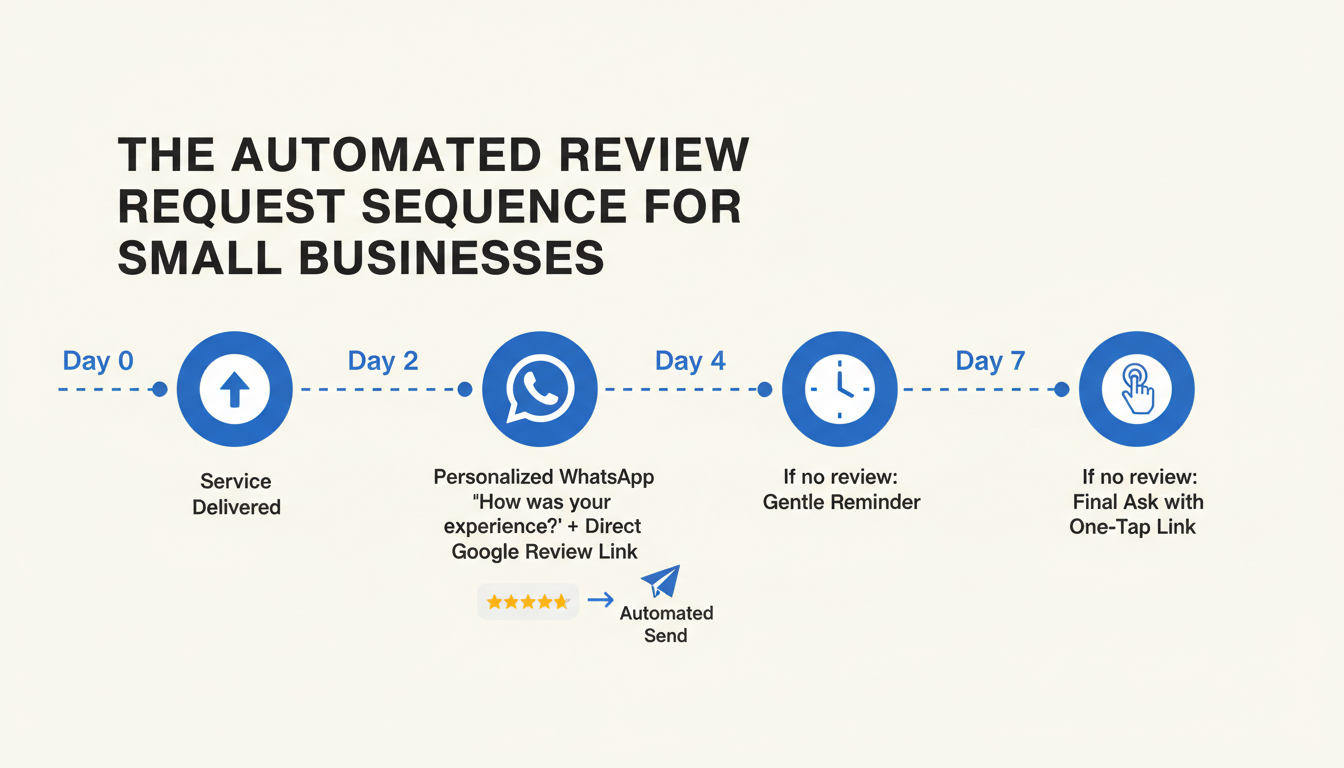
Here is what an optimised automated review request sequence looks like:
Day 2 Post-Service (Primary Ask): An automated WhatsApp message from your business: “Hi [Name], thank you for [visiting/using your service] with us on [Day]. We hope [treatment/product] has been working well for you! We’d love to hear your feedback — it means the world to a small business like ours. Could you spare 60 seconds to leave us a review? [Direct Google Review Link].”
Day 4 Post-Service (Gentle Reminder, if no review yet): “Hi [Name], just a quick follow-up from [Business Name]. We noticed you haven’t had a chance to share your experience yet — no pressure, but if you have a moment, we’d be truly grateful. [Direct Link].”
Day 7 Post-Service (Final Ask, if still no review): One final message, after which the sequence ends and the client is placed into a regular re-engagement campaign rather than continued review requests.
This three-touch sequence, properly configured, converts 25–40% of satisfied clients into active reviewers. For a business serving 50 clients per month, that is 12–20 new Google reviews every month — on autopilot.
How AI Monitors and Responds to Every Review Across Platforms
Review monitoring without a system means checking Google, Facebook, and other platforms manually — and usually discovering a negative review days or weeks after it was posted, when the damage is already done.
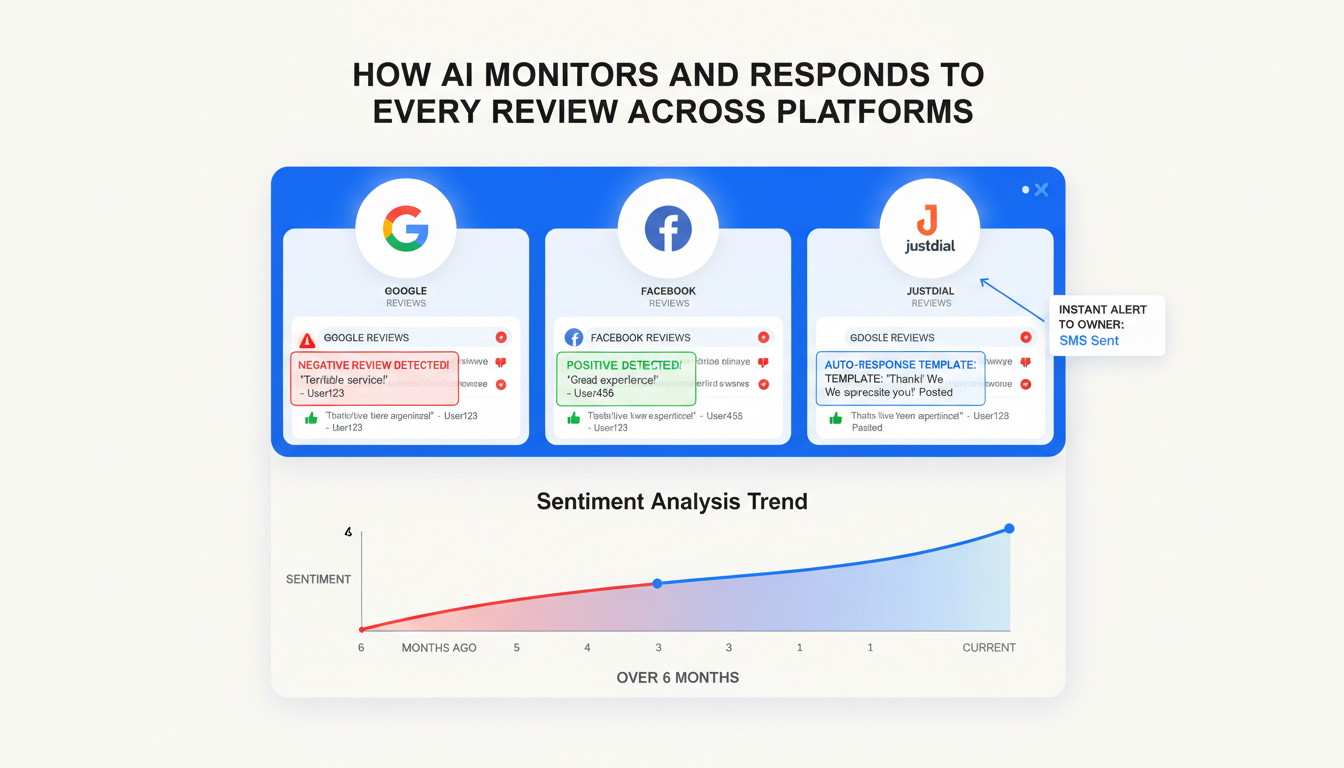
AI-powered reputation monitoring changes this by alerting you the moment a new review is posted across any platform, sentiment-analysing the content, and providing a suggested response — all within minutes of the review going live.
For positive reviews: the AI can auto-respond with personalised, non-generic responses that thank the reviewer by name and reference specific aspects of their experience (pulled from your CRM data). This signals to future readers that your business is actively engaged, not automated.
For negative reviews: the AI alerts the owner immediately with the full review text, the customer’s contact history from your CRM, and a suggested de-escalation response. You review, personalise slightly, and post within hours — demonstrating responsiveness that often converts the negative reviewer and reassures future readers who see the interaction.
Research consistently shows that a business that responds thoughtfully to negative reviews is trusted more than a business with only positive reviews and no responses. The response is the signal — it shows that you care and that issues get resolved.
What the Numbers Look Like: ORM Transformation in Practice
Small businesses that deploy automated review collection and active ORM typically see their Google review count increase by 800–1,200% within 12 months, with an average rating improvement from below 4.0 to above 4.6.
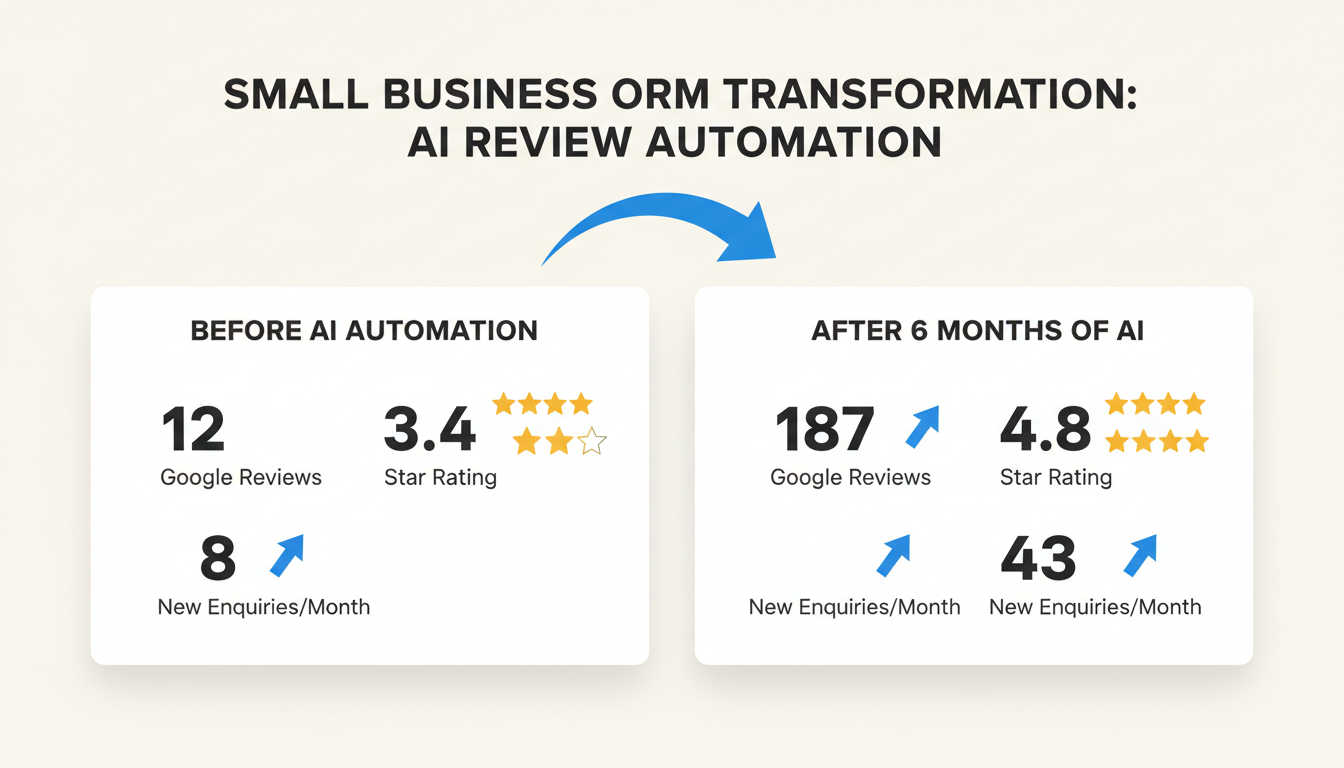
A typical small business scenario: 12 Google reviews, 3.4 star average, 8 organic enquiries per month from Google. After 6 months of automated review collection and active review response management: 187 reviews, 4.8 star average, 43 organic enquiries per month from Google. The only difference: a systematic review collection and response process.
The additional 35 enquiries per month from Google alone represent significant revenue. If your average client value is ₹20,000 and you convert 20% of those additional enquiries, that is 7 additional clients per month — ₹1,40,000 in monthly revenue. From reviews. From reputation. From something most small businesses leave entirely to chance.
Beyond Google: The ORM Platforms Every Small Business Should Monitor
For most small businesses, Google Business is the highest-priority ORM platform — but it is not the only one that influences buying decisions.
Depending on your industry and location, the following platforms should be monitored and actively managed: Justdial and Sulekha for Indian local services; Facebook Reviews for businesses with an active social presence; Industry-specific platforms (Practo for healthcare, Zomato/Swiggy for food businesses, MakeMyTrip for hospitality); and LinkedIn recommendations for B2B service providers.
An AI reputation monitoring system aggregates all of these into a single dashboard, so you see every review, every rating change, and every sentiment shift across all platforms in one place — without checking them individually.
Frequently Asked Questions About ORM for Small Businesses
Is it ethical to ask clients for reviews?
Absolutely. Asking satisfied clients to share their experience is standard business practice. What is not acceptable is incentivising reviews or manipulating their content. A simple, sincere ask sent at the right moment is both ethical and effective.
What if we get a negative review that is unfair or inaccurate?
Respond professionally and factually. If the review violates platform policies (fake, spam, or threatening), flag it for removal. For genuine negative feedback, a thoughtful response that acknowledges the issue and offers a resolution is the most effective approach — it demonstrates care and professionalism to everyone who reads it.
How long does it take to see ORM results?
Most businesses see their first significant improvement in review volume within the first 30 days of automated collection. Rating improvements typically become visible within 60–90 days as new positive reviews begin to outweigh older lower-rated ones.
Can ORM automation work for businesses with very few existing reviews?
Especially well. Starting from a low base, even 10–15 new positive reviews in the first month can dramatically shift your rating and visibility on Google. The compounding effect of consistent review collection is most dramatic in the first 3–6 months.
Your Reputation Is Your Most Powerful Marketing Asset. Start Building It Systematically.
Every satisfied client who walks out of your business without leaving a review is a missed marketing opportunity. Every negative review that goes unanswered is a missed chance to demonstrate professionalism. Online reputation management in 2026 is not a luxury for large businesses — it is a fundamental operating requirement for any small business that wants to grow through organic discovery.
Ready to find out how your current online reputation compares to your top local competitors? Get a Free SEO / Website Audit from Nexurate Technologies — including a full reputation analysis — and walk away with a clear roadmap to building a 5-star profile on autopilot.
