Top 5 CRM Automation Workflows for E-Commerce
E-commerce, CRM Automation, Marketing Automation Workflows
5 CRM Automation Workflows Every E-Commerce Brand Needs to Survive 2026
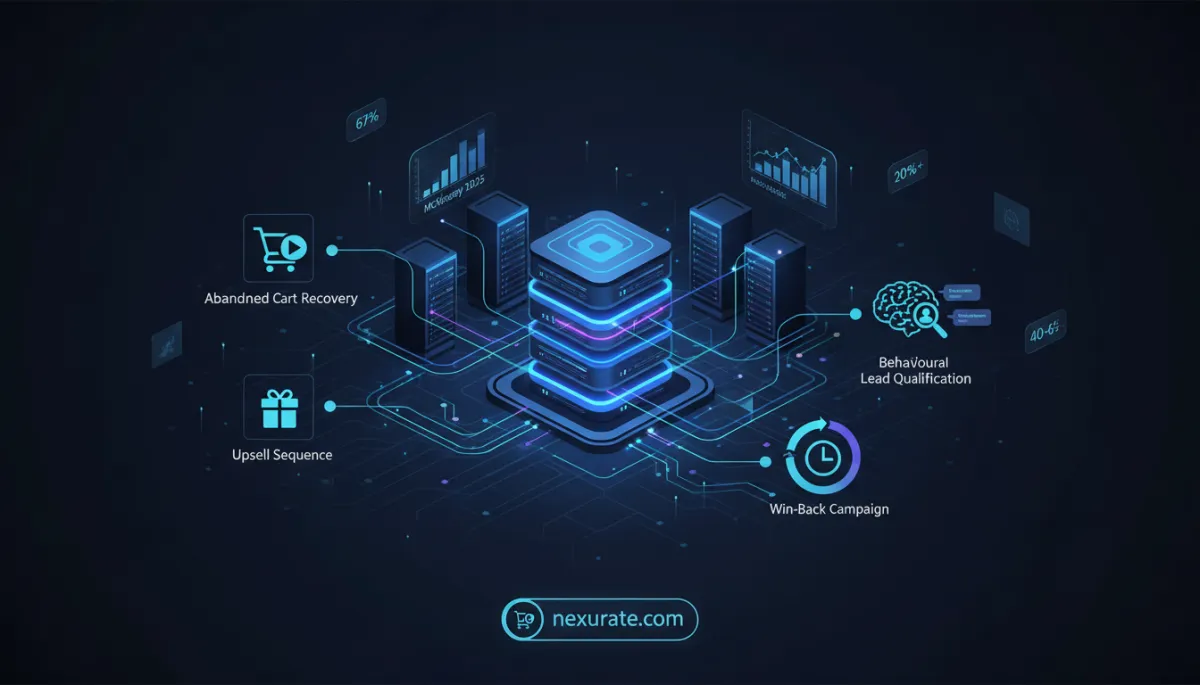
CRM automation for e-commerce has moved from “nice to have” to basic survival infrastructure. AI-powered workflows now drive abandoned cart recovery, lifecycle marketing, and ecommerce lead nurturing at a scale humans simply can’t match. McKinsey’s 2025 digital commerce analysis found that brands using AI and automation across the customer journey generated 32% more revenue per customer, and 67% of AI-adopting SMBs saw at least 20% revenue growth. Those gains are coming from a small set of high-impact, repeatable workflows like the five below.
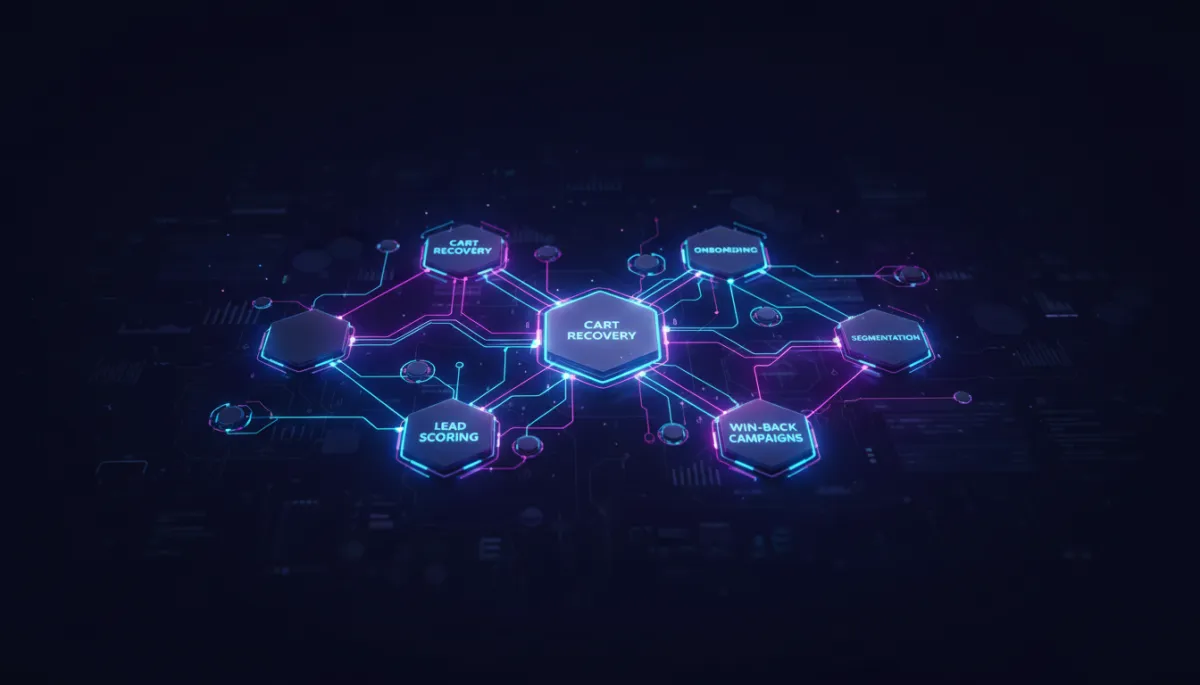
1. Abandoned Cart Recovery: 3-Touch Automation That Recovers 5–15% of Revenue
Cart abandonment is still one of the biggest leaks in e-commerce. Industry averages sit around 70%, but a well-built abandoned cart recovery workflow can recover 5–15% of those lost carts. At $100,000 in monthly cart value, that’s $3,000–$18,000 in extra revenue with zero additional ad spend.
The key is speed, relevance, and automation. Your CRM automation for e-commerce should trigger a three-step sequence across email, SMS, and (if applicable) push notifications:
- Touch 1 — Within 30 minutes: A gentle reminder that the cart is waiting, focused on convenience. Include product images, clear pricing, and a one-click return-to-cart link. No discount yet; just solve friction (payment options, shipping clarity, mobile checkout).
- Touch 2 — At 4 hours: A nudge that introduces urgency and social proof. Highlight low stock, reviews, or UGC. This is where behavioural data matters: reference the exact items they viewed and recommend 1–2 related products using your marketing automation workflows.
- Touch 3 — At 24 hours: A final win-or-learn message. If margin allows, add a small incentive (5–10% off, free shipping, or a bonus sample). Make the offer time-limited to push action.
To maximise results, ensure the workflow triggers on both logged-in users and identified guests (via captured email or phone at checkout start), and syncs with your ad platforms for retargeting the highest-value abandoners.
2. Post-Purchase Onboarding and Upsell: Days 1, 3, 7, and 14
The cheapest way to grow revenue in 2026 is to extract more value from customers you already paid to acquire. A structured post-purchase sequence turns one-time buyers into repeat customers and brand advocates, while reducing support tickets and returns. Think of it as lifecycle onboarding, not just a receipt email.
- Day 1 — Confirmation and expectations: Send a branded order confirmation that sets delivery expectations, shares tracking, and answers top FAQs. Include a short “what happens next” section and a one-click option to manage notifications via email or SMS.
- Day 3 — Education and usage tips: Deliver a value-first guide: how to set up, use, care for, or style the product. Short videos, GIFs, or step-by-step visuals work well. This reduces buyer’s remorse and makes your brand feel premium and supportive.
- Day 7 — Social proof and light upsell: Once the product has likely arrived, ask for a quick review or rating. Then introduce complementary products based on the exact SKU purchased (bundles, refills, accessories). This is where ecommerce lead nurturing merges with smart cross-sell logic in your CRM.
- Day 14 — Loyalty and subscription offers: Invite them into your loyalty program or subscription if relevant. Offer points, early-access perks, or members-only pricing. For consumables, this is the ideal moment to suggest a subscription based on average usage cycles.
When integrated properly, this workflow feeds data back into your CRM: product satisfaction, open/click behaviour, and review response all refine future segmentation and marketing automation workflows automatically.
3. Behavioural Segmentation for Campaign Personalisation
Batch-and-blast email is dead. In 2026, the brands winning on ROI are those using behavioural data to fuel dynamic segments inside their CRM. Instead of static lists, your CRM automation for e-commerce should tag and segment customers in real time based on what they do, not just who they are.
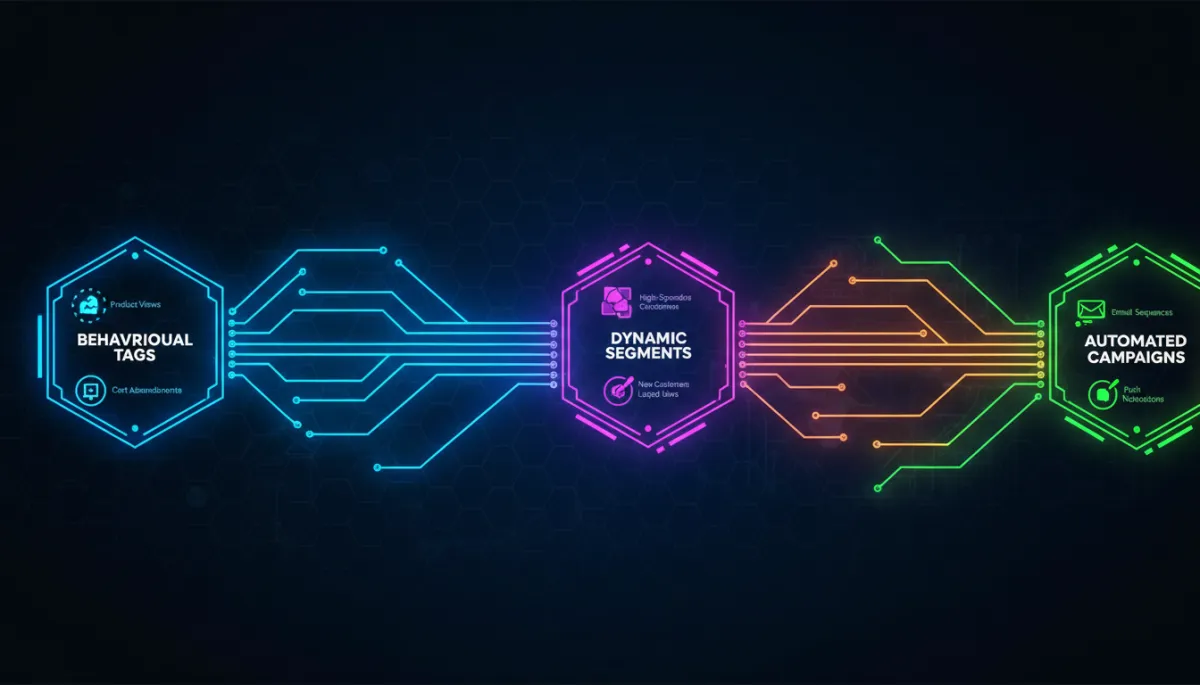
Dark tech style visual of an e-commerce CRM pipeline with nodes for behavioural tags, dynamic...
Start by defining a simple tagging framework that your CRM applies automatically whenever a key event happens:
- Browsing behaviour: Viewed category X three or more times, viewed a product but didn’t add to cart, returned to the same product page multiple times.
- Purchase behaviour: High AOV, frequent buyer, discount sensitive, subscription customer, first-time buyer, single-purchase only.
- Engagement behaviour: Opens 70%+ of campaigns, clicks on specific categories, inactive for 60/90/120 days, engages more with SMS than email, or vice versa.
Then create dynamic segments that update automatically as tags change. Examples:
- “High-value skincare repeat buyers who haven’t purchased in 60 days”
- “Sportswear browsers who viewed running shoes 3+ times but never added to cart”
- “New customers from paid social who opened the last 3 emails but didn’t click”
With this in place, your marketing automation workflows can trigger hyper-relevant campaigns: VIP early access for high-LTV customers, price alerts for discount-sensitive browsers, or educational sequences for first-time category buyers. The result is higher conversion, lower unsubscribe rates, and more efficient ad spend.
4. Automated Lead Qualification for B2B or Wholesale E-Commerce
If you sell wholesale, run a B2B arm, or work with distributors, treating every form fill the same is a fast way to burn sales capacity. In 2026, leading brands use AI-powered lead scoring and routing directly inside their CRM to prioritise the opportunities most likely to close and buy at scale.
An effective automated lead qualification workflow typically includes:
- Data enrichment: When a lead submits a wholesale or B2B inquiry form, your CRM automatically enriches the contact using third-party data: company size, industry, location, tech stack, and estimated revenue. No manual research.
- AI lead scoring: A scoring model evaluates each lead against your ideal customer profile and historical closed-won data. It weighs factors like company size, role seniority, geography, and website behaviour (pages viewed, pricing page visits, download activity).
- Routing and SLAs: High-scoring leads are instantly routed to the right sales rep or territory with clear follow-up SLAs (e.g., contact within 2 business hours). Lower-scoring leads enter an automated nurture sequence with educational content, case studies, and soft CTAs to book a call when ready.
This kind of automated qualification is where AI-driven CRM automation for e-commerce often delivers the fastest ROI. Studies across industries show 40–60% cost reduction in manual qualification efforts, while ensuring sales teams spend their time on leads with the highest probability of closing.
5. Win-Back Campaign for Lapsed Customers: 60/90/120-Day Sequences
Even with strong onboarding and segmentation, some customers will go quiet. That doesn’t mean they’re lost forever. A structured win-back sequence targeting 60-, 90-, and 120-day lapsed buyers can reactivate a surprising percentage of dormant customers at a fraction of new customer acquisition cost.
- 60 days — Reminder and relevance: A friendly “We miss you” message that highlights what’s new since their last purchase—new arrivals, improved products, or updated bundles. Use their past purchase data to showcase highly relevant items, not a generic catalogue blast.
- 90 days — Incentive and feedback: If they still haven’t purchased, introduce a modest incentive and ask a simple question: “Did something go wrong?” or “What stopped you from coming back?” This gives you both a conversion opportunity and qualitative data to improve your offer and experience.
- 120 days — Last chance and re-segmentation: A final, stronger offer (if margins allow) or a clear option to update preferences and reduce frequency. Customers who don’t respond can be downshifted to a low-frequency nurture list to preserve deliverability.
Combined with your behavioural segmentation, win-back flows become a powerful ecommerce lead nurturing engine: you’re not just sending three emails; you’re running a continuous, data-driven process that keeps your best-fit customers from slipping away quietly.
Bringing It All Together: Surviving (and Thriving) in 2026
The e-commerce landscape in 2026 is defined by AI, automation, and rising customer expectations. Global AI adoption is surging, and while ROI is uneven, the top performers are pulling away fast. McKinsey’s 2025 research shows that 67% of SMBs that adopted AI achieved 20%+ revenue growth, and other studies consistently report 40–60% cost reductions when brands automate high-volume workflows like the ones above.
For e-commerce store owners, online retail managers, and digital marketers, the question is no longer whether to implement CRM automation for e-commerce—it’s whether your workflows are mature enough to stay competitive. If you don’t have:
- A three-step abandoned cart recovery flow recovering 5–15% of lost carts
- A post-purchase onboarding journey mapped to days 1, 3, 7, and 14
- Behavioural tagging and dynamic segments driving personalised campaigns
- Automated lead qualification and routing for B2B or wholesale inquiries
- Structured win-back sequences at 60/90/120 days for lapsed buyers
…then you’re likely leaving significant revenue on the table and overspending on acquisition to compensate. The brands that will survive and grow through 2026 are those that treat these workflows as core infrastructure, not experiments.
