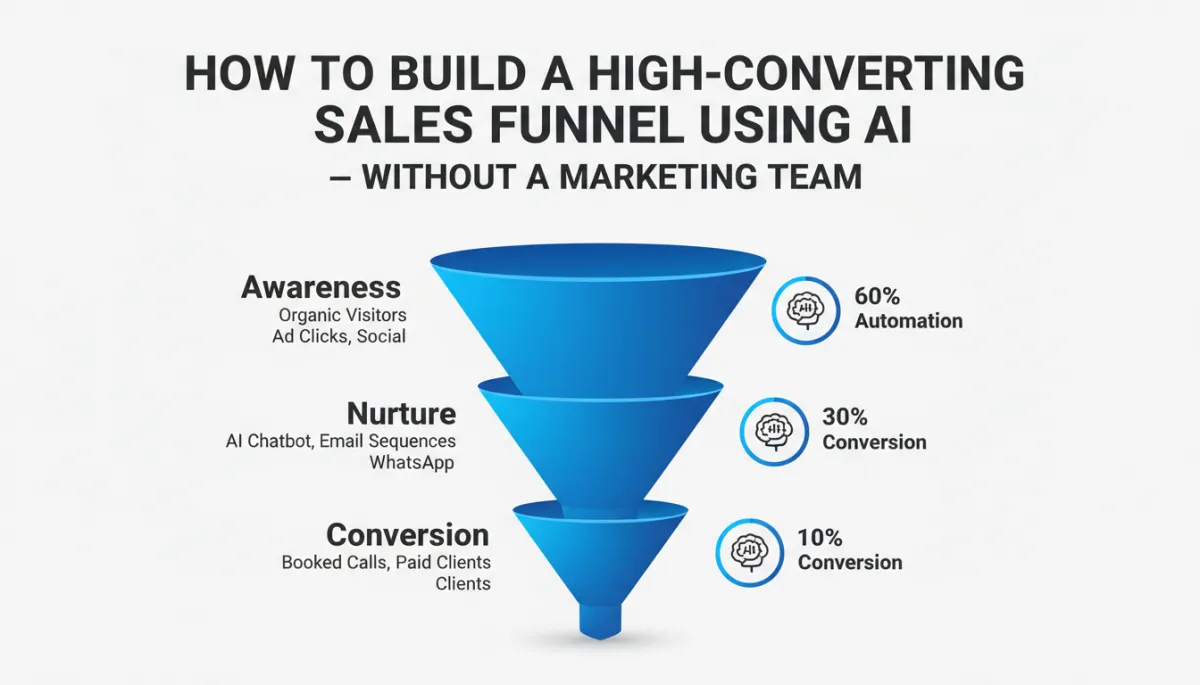
How to Build a High-Converting Sales Funnel Using AI — Without a Marketing Team
The term “sales funnel” used to mean expensive agency retainers, marketing teams, complex technology stacks, and months of setup. In 2026, it means none of those things. A well-built AI-powered sales funnel can be deployed by a business owner with zero marketing experience, using tools that connect seamlessly, and it runs automatically from the moment the first visitor arrives to the moment they become a paying client.
Here is exactly how to build one — stage by stage — without a marketing team.
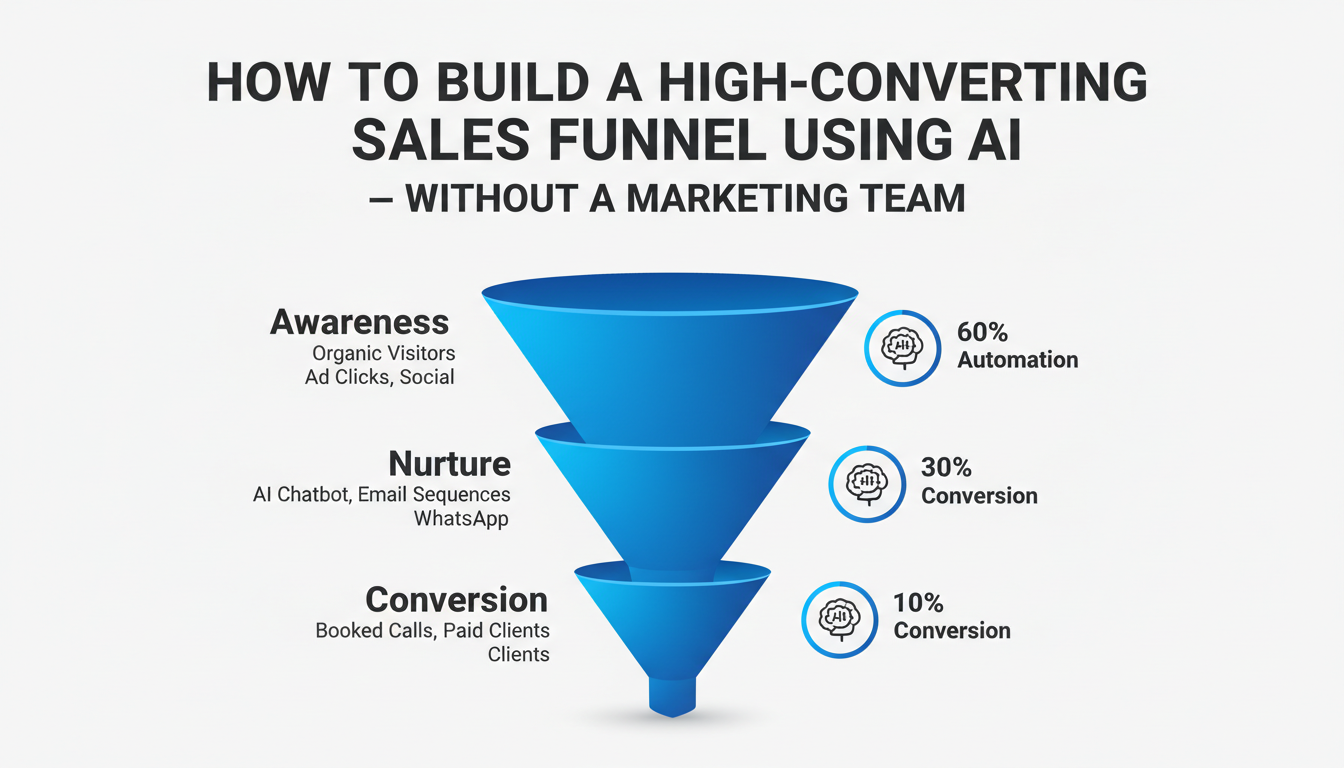
What Is an AI Sales Funnel — And How Is It Different from a Traditional One?
A traditional sales funnel requires humans to manually move leads from one stage to the next. An AI sales funnel automates every transition — using behaviour signals to trigger the right message, at the right time, for the right person — without manual intervention.
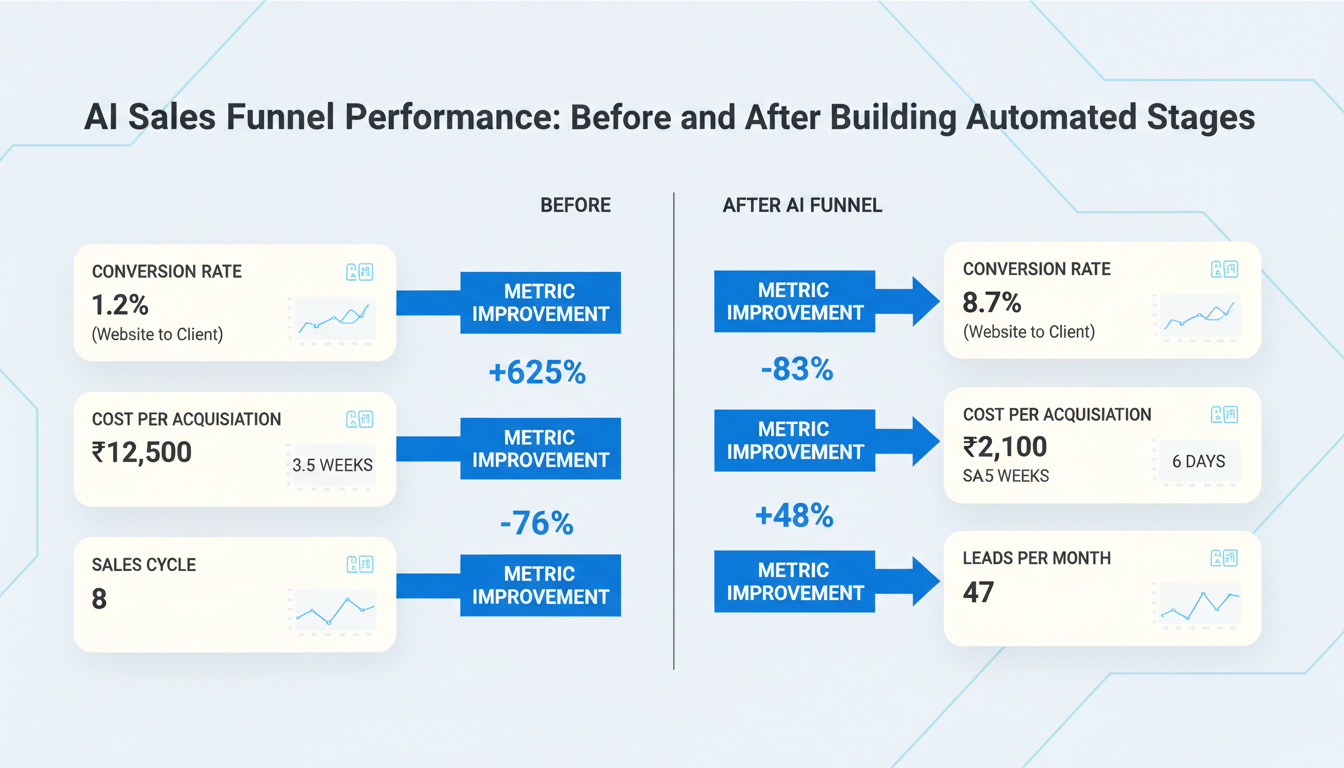
The key difference: a traditional funnel converts at 1–3% because most leads fall through the gaps between stages. An AI funnel is designed to catch every lead at every gap — automatically re-engaging them when they disengage, advancing them when they show intent, and surfacing them to a human only when they are genuinely ready to buy. Conversion rates of 8–15% from the same traffic volume are consistently achievable with a well-configured AI funnel.
Stage 1 — Top of Funnel: Attracting and Capturing Leads
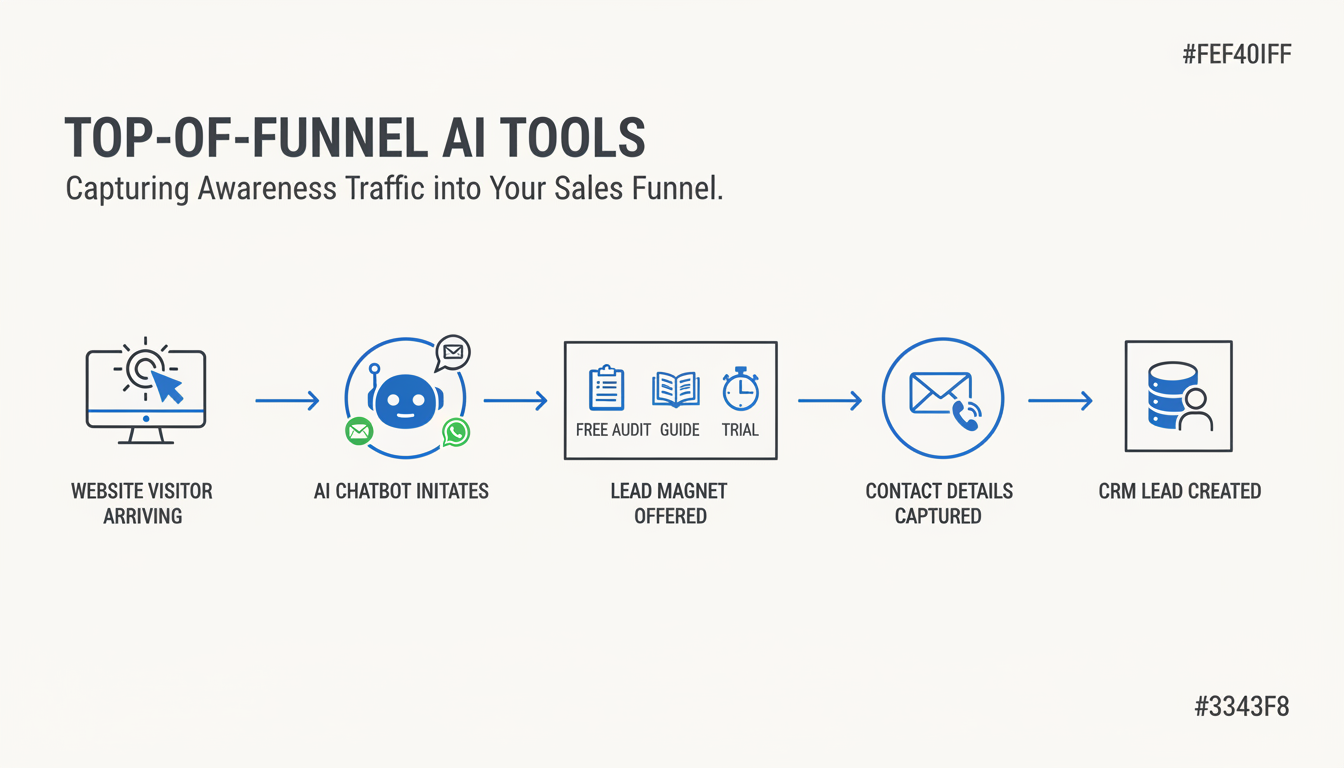
The top of funnel is where potential clients first encounter your business — through your website, social media, ads, or organic search. The AI’s job here is to capture their contact details before they leave.
The primary TOFU tools: an AI chat widget that proactively engages visitors based on the page they are browsing; a lead magnet (free audit, checklist, guide, or trial offer) delivered in exchange for an email or WhatsApp number; a WhatsApp click-to-chat button that converts browsers into active conversations; and exit-intent capture that fires a value offer when visitors show signs of leaving.
The goal of Stage 1 is singular: get the contact detail. Not the sale. Not the booking. The detail. Everything else follows from that. For most SME websites without TOFU AI tools, 97–99% of visitors leave without providing contact information. With AI TOFU tools, 8–15% of visitors provide their details — a 5–10x improvement from the same traffic.
Stage 2 — Middle of Funnel: Nurturing Leads Toward a Purchase Decision
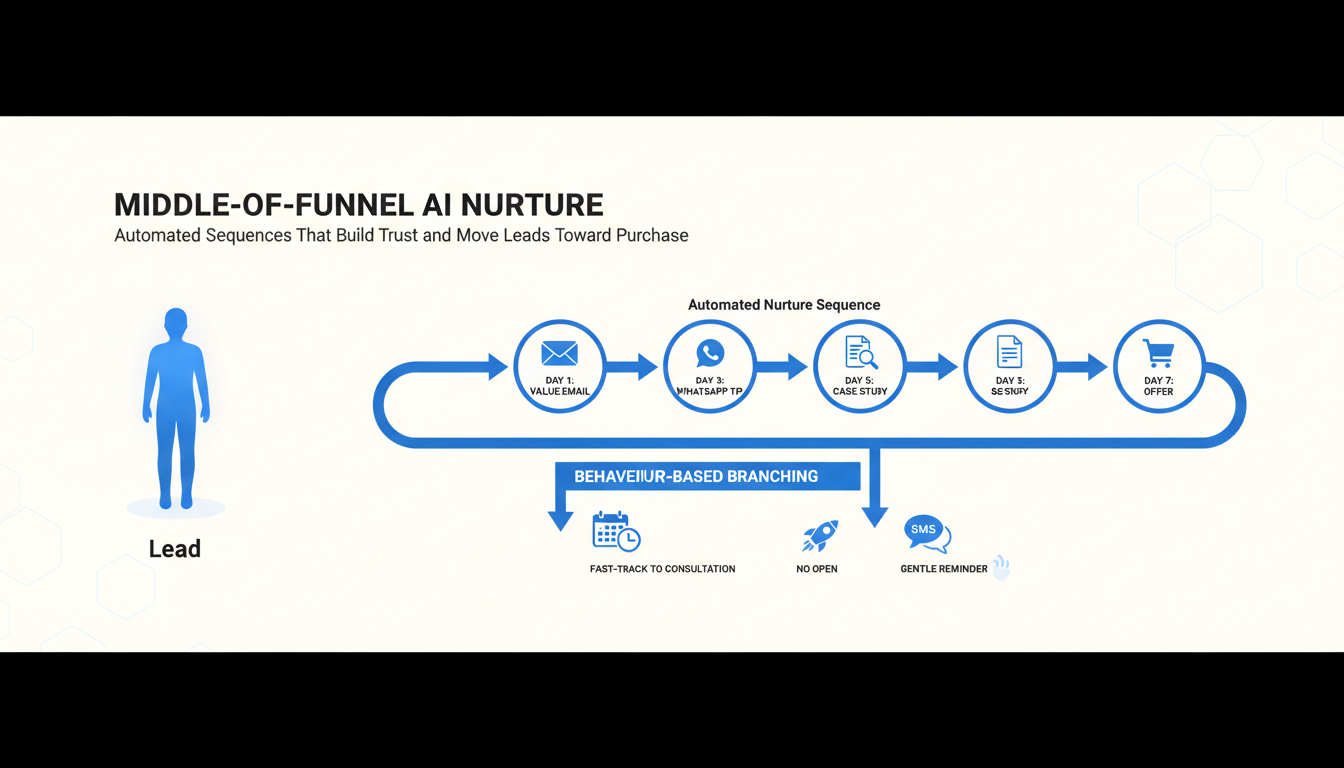
The middle of funnel is where most businesses fail. A lead provides their contact details and hears nothing — or receives a generic, one-size-fits-all email sequence that fails to address their specific situation. The AI’s job here is to deliver the right content, at the right time, based on individual behaviour.
An effective MOFU AI nurture sequence for most service businesses follows this structure: Day 1 — an immediate, personalised welcome message that confirms what they will receive and sets expectations; Day 2 — a piece of genuinely useful content relevant to the problem they expressed interest in; Day 4 — a case study or testimonial from a client who started in a similar situation; Day 6 — a direct, low-friction offer (free consultation, free audit, free trial) with a clear booking link; Day 8 — a FAQ-format message addressing the most common objections your sales team hears; Day 10 — a final, time-limited offer with a clear deadline.
The critical difference between a static nurture sequence and an AI-powered one: the AI monitors behaviour throughout. A lead who clicks the booking link on Day 4 is immediately moved to Stage 3 — they do not need Days 6–10. A lead who opens every email but does not click is flagged for personal outreach. A lead who goes dark receives a re-engagement message after 7 days of inactivity. Every lead is treated individually, not as part of a mass list.
Stage 3 — Bottom of Funnel: Converting Nurtured Leads into Clients
The bottom of funnel is where the decision happens. By the time a lead reaches Stage 3, they have been educated, they trust your brand, and they are actively considering a purchase. The AI’s job here is to remove the final barriers and make the conversion frictionless.
The BOFU tools that convert most effectively: an AI chatbot on your booking or pricing page that answers final questions in real time; automated calendar booking that lets the lead schedule a consultation or trial without waiting for a human to confirm; social proof injection — showing reviews, testimonials, or live client counts at the exact moment the lead is making their decision; and a time-limited offer that creates urgency without pressure. Once a lead converts, the AI immediately triggers an onboarding sequence: booking confirmation, what to expect, intake form, and the first touch of your client retention system.
What Your AI Funnel Numbers Should Look Like After 90 Days
A well-built AI sales funnel, given 90 days of live operation and optimisation, should achieve these benchmarks for most SME contexts: TOFU conversion (visitor to lead) 8–15%; MOFU conversion (lead to consultation/trial booking) 25–40%; BOFU conversion (consultation to paying client) 40–60%; overall funnel conversion (visitor to client) 3–10%.
For a website receiving 500 visitors per month, a 5% end-to-end conversion rate means 25 new clients per month — from the same traffic. At an average service value of ₹20,000, that is ₹5,00,000 per month in revenue directly attributable to your AI funnel. Compare that to the same 500 visitors without an AI funnel: typically 3–6 enquiries, 1–2 clients, ₹20,000–40,000 in funnel-attributed revenue.
The Tools You Need to Build Your AI Funnel — And What You Do Not Need
You do not need an expensive marketing agency, a dedicated marketing team, or a complex tech stack to build a functional AI sales funnel. You need: an AI CRM platform, a website with a basic landing page, a WhatsApp Business API account, and an email service. That is it.
The AI CRM is the central hub. It manages your contacts, triggers your automations, scores your leads, tracks your conversions, and shows you exactly where your funnel is performing and where it needs improvement. Everything else connects into it.
Setup time for a basic but functional AI sales funnel with all three stages: 3–5 days. Setup time for a fully optimised funnel with A/B tested messages, behavioural scoring, and channel-specific sequences: 2–3 weeks. Both are well within reach of a business owner willing to invest a few hours of their time.
Frequently Asked Questions About AI Sales Funnels
Do I need any technical skills to set up an AI sales funnel?
No. Modern AI CRM platforms are built for non-technical business owners. The setup process is largely configuration — writing your messages, setting your timing rules, connecting your channels — rather than coding or development.
How do I know if my AI funnel is working?
Your CRM dashboard shows you conversion rates at every stage, which messages are being opened and clicked, where leads are dropping off, and what your overall lead-to-client conversion rate is. All of this data is available in real time, allowing continuous improvement.
What if I already have a website but no lead magnet?
Start with a free consultation or free audit offer — the lowest-effort, highest-converting lead magnet for most service businesses. For Nexurate clients, a free SEO and website audit is an excellent entry point that demonstrates immediate value and positions the business for a natural next conversation.
Build Your Funnel Once. Let It Sell for You Forever.
The most powerful thing about an AI sales funnel is that it does not stop working at 6 PM. It does not take weekends off. It does not forget to follow up. Once built, it operates 24/7 — capturing, nurturing, and converting leads at every hour of the day, every day of the year, with zero additional cost per lead and zero additional time from you.
Ready to build your AI sales funnel? Get a Free SEO / Website Audit from Nexurate Technologies — and walk away with a custom AI funnel blueprint built for your specific business, audience, and revenue goals.
