50% of Businesses Use AI for SMS Marketing
Marketing, AI SMS Marketing Automation
50% of Businesses Now Use AI for SMS Marketing — Here Is What You Are Missing
AI SMS marketing automation has moved from “early adopter experiment” to mainstream revenue engine. If you are still sending generic blasts, you are quietly handing customers — and profit — to competitors who let algorithms do the heavy lifting.
SMS: The Highest Open-Rate Channel in 2026 — and Still Underused
In 2026, SMS marketing sits in a category of its own. Multiple benchmark reports place SMS open rates between 90% and 98%, with many brands seeing closer to the 95–98% mark (Shopify, MessageFlow, Digital Applied). One provider reports that 90% of texts are seen within three minutes and 97% within an hour. In other words, if you send a text, your customer almost certainly sees it — something email, social and display ads simply cannot match.
Yes, “open rate” in SMS is inferred rather than pixel-tracked, but the structural reality is clear: your message lands directly on the lock screen of a device people check over 100 times a day. That is why consumer surveys show 85–89% of people have opted in to business texts, and 74–87% check new messages within minutes (EZ Texting, SimpleTexting).
For marketing managers and SME owners, this makes SMS the highest-visibility channel in 2026. The real question is no longer “does SMS get seen?” but “what do you do with that attention?” This is exactly where AI SMS marketing automation changes the game.
The AI SMS Surge: Budgets and Ambitions Are Already There
Across ecommerce and B2C sectors, AI is rapidly becoming the default engine behind SMS marketing 2026. Omnisend’s 2025–2026 data shows:
- 50.4% of businesses plan to use AI personalisation for SMS — not just for email or web, but specifically for text messaging (Omnisend 2025).
- Brands are increasing AI-powered SMS spend by 60% or more, chasing higher ROI from automated SMS campaigns.
Other studies echo the same pattern. SimpleTexting reports that 71% of businesses say AI has improved their SMS results, saving 4–6 hours per week. TextUs finds that teams pairing AI with SMS are 26 percentage points more likely to say SMS outperforms email. The direction of travel is unmistakable: AI SMS marketing automation is now a competitive baseline, not a nice-to-have experiment.
Beyond First Names: How AI Personalises SMS by Behaviour, Intent and History
Many SMEs think they are “doing personalisation” because their texts start with “Hi Sarah”. That is table stakes. Modern AI personalisation SMS goes several layers deeper, using:
- Behaviour: AI engines analyse browsing paths, clicks, abandoned categories and engagement patterns. A customer who repeatedly checks running shoes but never buys gets a different SMS than someone exploring formal wear.
- Intent: By looking at recency, frequency and depth of interactions, AI scores how “ready” someone is to purchase. High-intent users receive stronger calls-to-action and limited-time offers; low-intent subscribers see softer education or social proof.
- Purchase history: Algorithms surface complementary products, replenishment reminders and logical next steps. Someone who bought a printer gets toner refills; a salon client who booked colour six weeks ago receives a gentle “refresh” reminder, not a generic discount.
Crucially, AI SMS marketing automation does this at scale. Whether you have 500 or 50,000 subscribers, every person can receive a message tailored to their lifecycle stage, value and likelihood to convert — without your team manually segmenting spreadsheets every week.
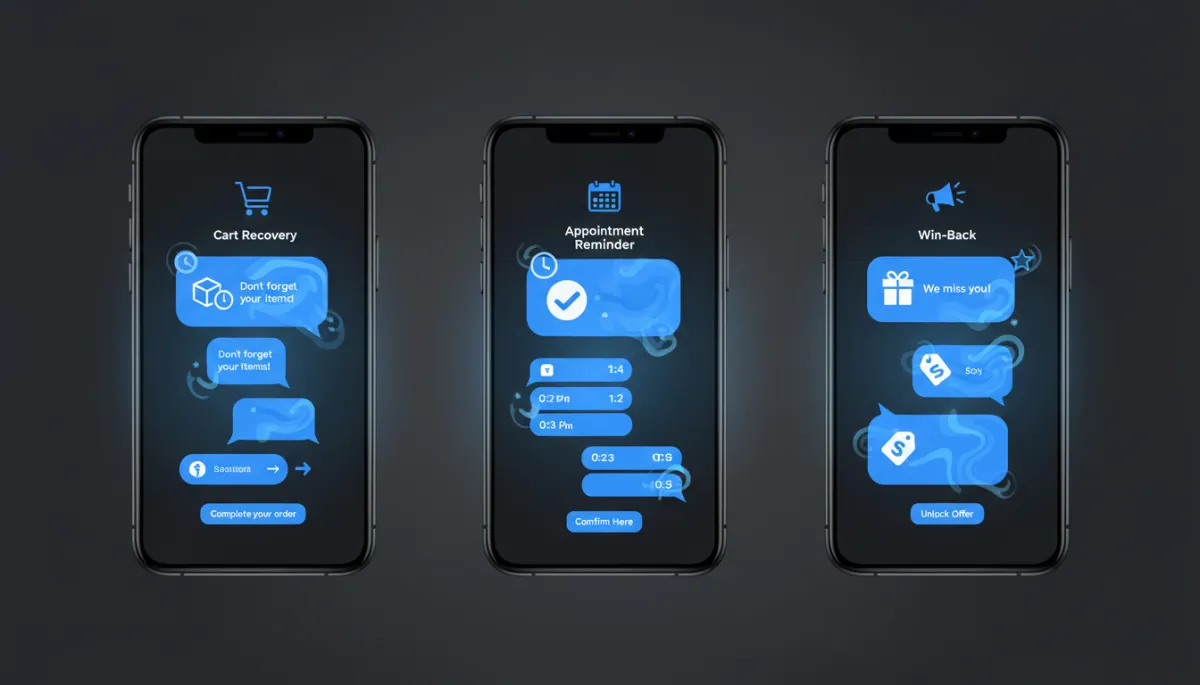
AI turns one subscriber list into thousands of micro-segments, each receiving precisely timed texts.
Real AI SMS Automation Sequences That Print Revenue
High-performing brands are not just sending one-off broadcasts. They are building always-on AI-driven flows that fire automatically when behaviour changes. Here are four sequences any marketing manager or SME can deploy quickly.
1. Abandoned Cart SMS Flows
Omnisend’s data shows automated SMS flows generate several times more revenue per message than standard campaigns. Abandoned cart is the classic example. With AI SMS marketing automation, you can:
- Trigger a reminder 30–60 minutes after cart abandonment, with dynamic product names and images (via link).
- Adjust tone based on cart value and customer status — VIPs may receive free express shipping; first-timers see a small welcome incentive.
- Optimise send time automatically, as AI learns when each customer is most likely to click.
2. Appointment Reminder & No-Show Recovery
For clinics, salons, consultants and home services, missed appointments are pure margin leakage. SMS is already the preferred channel for reminders in consumer surveys. AI can layer on intelligence by:
- Sending reminders at different intervals based on past behaviour (e.g., chronic latecomers get earlier nudges).
- Offering one-tap rescheduling links to protect revenue instead of losing the booking entirely.
- Triggering follow-ups to fill cancelled slots with nearby customers who have shown high intent but not yet booked.
3. Win-Back and Re-Engagement Campaigns
Most lists are full of “sleeping” buyers. AI can automatically identify lapsed customers — for example, those who have not purchased in 90 or 180 days — and segment them by previous spend, category preference and discount sensitivity. Then it can:
- Craft different win-back offers for high-value vs. low-value segments.
- Test multiple angles (loyalty rewards, new arrivals, social proof) and auto-shift budget to the best-performing versions.
4. Post-Purchase Upsells and Cross-Sells
The most profitable SMS often arrive after the first sale. Using purchase history, AI can schedule:
- “Complete the set” offers a few days after delivery, featuring accessories that previous buyers commonly add.
- Replenishment reminders timed to typical usage cycles (e.g., vitamins, skincare, pet food).
- VIP early access to launches, prioritising customers with the highest predicted lifetime value.
30% Higher Conversions: The Measurable Impact of AI Personalisation
Visibility is only half the story. The reason budgets are flooding into AI SMS marketing automation is performance. Across platforms and case studies, AI-personalised SMS campaigns consistently deliver around 30% higher conversion rates than generic, one-size-fits-all messaging.
Omnisend’s benchmarks show automated SMS flows (which are typically AI-optimised) generating more than 4–5x the revenue per message of bulk campaign sends. Ringly.io reports that while automated flows account for just 7.6% of SMS volume, they drive 45.2% of SMS revenue. When you combine this automation with AI-driven segmentation and timing, that uplift typically lands in the 25–35% conversion range versus static campaigns.
How to Launch AI SMS Marketing Automation in 30 Days
Implementing AI SMS does not require a data science team. With the right approach, most marketing managers and SME owners can get a solid program running in 30 days.
Week 1: Choose Your Platform and Connect Data
- Select an AI-capable SMS platform. Look for built-in AI personalisation SMS features, behaviour-based triggers, and integrations with your ecommerce, CRM or booking system.
- Sync your customer and order data. At minimum, pull in phone numbers, consent status, purchase history, last activity date and key tags (e.g., VIP, category interest).
Week 2: Build Core Automated SMS Campaigns
- Launch an abandoned cart flow targeting all opted-in users with at least one item in cart and no purchase in X hours.
- Set up post-purchase sequences for order confirmation, delivery updates, and a follow-up cross-sell or review request.
- If you are appointment-based, create reminder and no-show recovery flows with one-tap rescheduling.
Week 3: Turn On AI Personalisation and Optimisation
- Enable AI-driven send-time optimisation so each subscriber receives texts when they are most likely to engage.
- Use AI to generate message variants (different hooks, offers and CTAs) and run continuous A/B tests. Let the system automatically back winners and retire underperformers.
- Activate behaviour-based segments — high-intent browsers, repeat buyers, at-risk churn — and feed each a tailored journey.
Week 4: Measure, Refine and Scale
- Track CTR, conversion rate and revenue per message for each flow. Do not obsess over “open rate” — SMS is already near 98% visibility.
- Double down on flows with the highest ROI (often abandoned cart and post-purchase) and gradually add win-back and VIP campaigns.
- Ensure compliance and trust: keep opt-out frictionless, respect frequency caps, and use AI to avoid spammy repetition.
Stop Leaving Revenue on Read
In 2026, SMS is not just another channel — it is the most visible, fastest-responding channel you have. When half of businesses are already planning AI-powered SMS personalisation and many are increasing investment by 60%+, staying with generic blasts is equivalent to leaving money on the table every single day.
AI SMS marketing automation lets you turn that 95–98% visibility into predictable revenue: smarter segmentation, higher conversions and flows that keep selling while your team focuses on strategy, not manual sending. The technology is ready. Your customers are opted in. The only missing piece may be a clear roadmap tailored to your website, SEO and funnel.
