AI Reputation Management for SMEs in 2026
Marketing, Online Reputation Management, AI Reputation Management
Online Reputation Management for SMEs: Build 5-Star Trust with AI in 2026
Your business's reputation is no longer just shaped by word of mouth — it's being defined in real time by AI search engines, Google reviews, and social media conversations. In 2026, when a potential client searches for your services, AI tools like ChatGPT, Google's AI Overview, and Perplexity are synthesising your online reputation before a human ever clicks a link. If your reviews are sparse, negative, or poorly managed, that's exactly what AI serves up as a first impression. The global ORM market is growing at a 14% CAGR, and for good reason. Ninety percent of consumers read online reviews before making a purchase. One negative review left unanswered can quietly cost you dozens of clients. For SMEs competing without enterprise-grade PR teams, AI-powered reputation management tools have become the great equaliser — making it possible to monitor, respond, and proactively build trust at a scale that was previously impossible. In this guide, we'll show you exactly how AI-driven ORM works and how your business can implement it starting today.

Why Online Reputation Management in 2026 Starts with AI Summaries
Online reputation management is no longer limited to what appears on the first page of Google. In 2026, AI-generated summaries have become the new “homepage” of your brand. Fast Company notes that many users now stop at AI summaries from tools such as ChatGPT and Google AI Overviews before clicking any link, meaning these answers often form the true first impression of your business.
Status Labs’ 2026 white paper highlights that ChatGPT alone processes around 2.5 billion daily queries, and up to 60% of searches now end without a click. AI systems typically reference only 2–7 domains in their responses, compared with 10 blue links on a traditional search results page. For SMEs, this creates both a threat and an opportunity: if your reviews, listings, and content are weak, AI will amplify that weakness; if they are strong and consistent, AI becomes a powerful trust engine working on your behalf.
ORM for Small Businesses: From Damage Control to Daily Discipline
Historically, ORM for small businesses meant calling an agency only when a crisis hit: a bad press article, a viral complaint, or a flood of poor reviews. In 2026, leading SMEs treat reputation as infrastructure, not an emergency service. Research from Reputation Inc shows that reputation is now woven into governance, operations, and culture, rather than bolted on as a PR function.
Vendasta’s 2026 State of Reputation Management report found that 74.5% of SMBs consider online reputation management “critically important,” yet many still rely on manual workflows and fragmented tools. The gap is no longer awareness; it is execution at scale. That is where AI reputation management becomes essential: it automates monitoring, prioritises what matters, and guides your team toward consistent, timely action without adding headcount.
How AI Reputation Management Actually Works
AI reputation management combines monitoring, analysis, and response into one intelligent layer across search, reviews, and social channels. Instead of manually checking multiple platforms each day, AI tools ingest this data in real time and surface the signals that most affect your brand trust and revenue.
- AI search visibility monitoring. Tools like LLM Pulse, SentimentStack, Sight AI, and Semrush’s AI Visibility Index track how AI systems describe your brand, which sources they cite, and how you compare with competitors in generative answers. For SMEs, this is your early-warning radar for how AI sees you today—and what prospects will read tomorrow.
- AI-enhanced review and social listening. Platforms such as Praising.ai, Birdeye, Brand24, Hootsuite, and Reputation.com use natural language processing to summarise sentiment, detect emerging issues, and recommend or even draft responses. Instead of reading hundreds of reviews and comments, you receive clear insights and suggested actions.
- Automated workflows. Modern ORM platforms trigger review requests after key customer touchpoints, route negative feedback to the right owner, and escalate high-risk issues. This reduces the operational burden on already-stretched SME teams while improving response speed and consistency.
The result is a system that continuously captures customer feedback, translates it into insight, and helps you respond in a way that both humans and AI search engines recognise as trustworthy and responsible.

Centralised AI dashboards let SMEs manage multi-platform reviews in minutes, not hours.
Google Review Management: Your Most Visible Trust Signal
For most SMEs, Google review management remains the single most impactful part of online reputation management. Google Business Profiles feed directly into local search results, maps, and increasingly into AI-generated overviews. When AI tools summarise “best accountants in Dubai” or “top IT support in Manchester,” they heavily weight review volume, recency, and response behaviour as signals of reliability and service quality.
Effective Google review management in 2026 involves three core practices:
- Consistently generating new, authentic reviews. AI-enabled platforms such as Praising.ai automate personalised review invitations via email, SMS, or WhatsApp after key milestones—like a project completion or successful delivery—while avoiding spammy tactics that could trigger platform penalties.
- Responding to every review, not just the negative ones. The ICDS Global Digital Trust Outlook 2026 highlights that “silence” is now one of the strongest predictors of reputational vulnerability. When you do not respond, both customers and algorithms infer that you are disengaged or indifferent.
- Turning negative feedback into proof of reliability. A professional, timely response that acknowledges the issue, explains the fix, and invites offline resolution can transform a 1-star complaint into evidence that your business is accountable and customer-centric.
Building Brand Trust: From Stars and Scores to Real Signals
Brand trust in 2026 is built faster and lost more quickly than ever. The ICDS report notes that the average window between a new trust signal and a real-world behavioural consequence is just nine days. A wave of positive reviews can rapidly boost enquiries; a cluster of unresolved complaints can slow your pipeline within a week.
For SME leaders, this means treating every public interaction as a trust asset. ORM for small businesses should focus on three layers of brand trust:
- Foundational hygiene. Accurate business listings, consistent NAP data (name, address, phone), up-to-date opening hours, and fast responses to messages. AI tools can flag inconsistencies automatically, protecting you from avoidable frustration and lost leads.
- Social proof at scale. A steady stream of recent, detailed reviews across Google, industry platforms, and social media. These reviews provide the raw material that AI systems use to summarise your strengths and weaknesses.
- Narrative control. Thought leadership content, case studies, and press mentions that explain what you stand for and who you serve best. Because AI systems cite only a small number of sources, a handful of high-quality articles can significantly influence how you are described in AI answers.
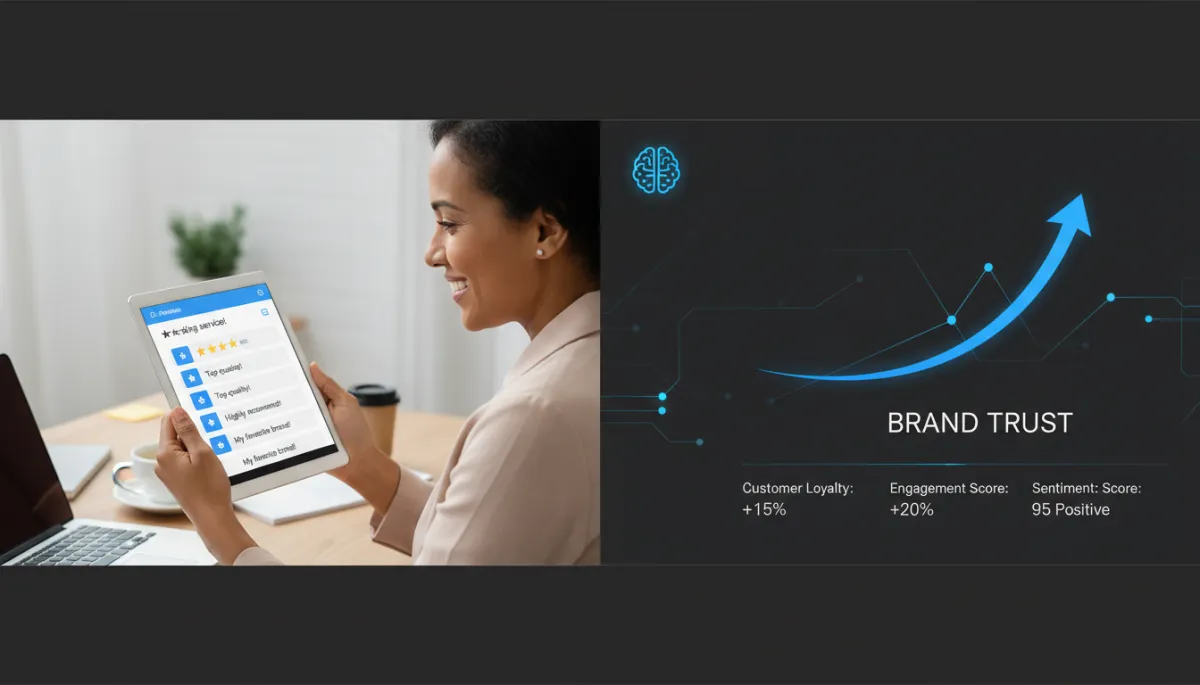
Consistent reviews and transparent responses compound into measurable, AI-recognised brand trust.
A Practical 5-Step ORM Action Plan for SMEs in 2026
Turning AI reputation management from theory into practice does not require an enterprise budget. It does require structure and ownership. The following five-step plan is designed for SME owners, CEOs, and marketing leaders who want to build durable brand trust in 2026:
- Audit your current online reputation. Search your brand in Google, ChatGPT, Perplexity, and Gemini. Note how you are described, which sites are cited, and what your review profiles look like across Google, industry platforms, and social channels. This is your baseline.
- Choose an integrated ORM stack. Combine at least one AI search visibility tool (e.g., LLM Pulse, SentimentStack, Sight AI, or Semrush’s AEO tools) with an AI-powered review and social platform (such as Praising.ai, Birdeye, Brand24, or Hootsuite). Ensure your team can manage everything from a single dashboard.
- Operationalise Google review management. Define who is responsible, how quickly you will respond, and what tone you will use. Configure automated review requests after key customer milestones and set alerts for low-star reviews so that issues are addressed within 24–48 hours.
- Align internal culture with external promises. Reputation Inc’s research shows that many reputational failures originate inside the organisation. Make sure your service levels, employee behaviour, and policies match the expectations your marketing sets. AI can highlight recurring complaint themes; leadership must address root causes.
- Review metrics monthly and refine. Track review volume, average rating, response time, sentiment trends, and how AI tools describe your business over time. Use these insights to refine your customer experience, content strategy, and escalation processes.
Governance, Ethics, and Risk: Reputation Is Now a Board-Level Issue
Forbes reports that by 2026, 46% of organisations have formal board-level processes for managing reputation risk, up sharply from 15% in 2024. While your SME may not have a board committee, the message is clear: reputation is a strategic risk, not just a marketing metric. Cyber incidents, supply-chain issues, and employee conduct can all trigger reputational shocks that AI systems will immediately surface and amplify.
At the same time, stakeholders expect transparency around how you use AI. Grayling’s 2026 Trends Report notes that 62% of business leaders are concerned about AI’s reputational implications, particularly where governance is weak. To protect brand trust, be explicit about when you use AI-generated content, how you safeguard customer data, and where human accountability sits in your decision-making processes.
Turn AI into Your 24/7 Reputation Ally
The global ORM market is projected to reach between USD 7.8 and 18 billion by 2026, depending on scope, with services segments alone growing at double-digit CAGRs. That growth reflects a simple reality: in a world where AI summarises your brand before prospects ever reach your website, you cannot afford to leave your online reputation to chance.
For SMEs, the playing field has never been more level. AI reputation management tools give you the visibility, insight, and automation that once belonged only to large enterprises. By treating ORM for small businesses as a core operational discipline—anchored in Google review management, proactive monitoring, and a culture of accountability—you can turn every search, every review, and every AI summary into an asset that compounds brand trust over time.
If you are ready to see how your business currently appears to both search engines and AI tools—and where the quickest wins lie—now is the time to act.
Call to Action: Get a Free SEO / Website Audit at nexurate.com/free-audit.
