
Boost Sales with AI-Powered Predictive Lead Scoring
Sales, Predictive Lead Scoring, AI CRM
Predictive Lead Scoring: How AI CRMs Help SMEs Focus on the Right Prospects First
Not every lead is worth the same amount of your team's time. Yet most SMEs treat all prospects equally — following up on every enquiry with the same sequence, regardless of whether the person is ready to buy or just browsing. This is one of the most expensive inefficiencies in small business sales, and it's almost entirely invisible on a standard spreadsheet. Predictive lead scoring, powered by AI, solves this problem at its root. By analysing patterns across your existing customer data — email opens, website visits, response times, deal stages, industry, company size — AI assigns each new lead a score that predicts how likely they are to convert. Your sales team then focuses its attention on the prospects with the highest probability of closing, while lower-scored leads are nurtured automatically through workflows. Companies using AI-powered lead scoring are reporting 30% higher win rates and 25% faster deal cycles. For SMEs with small sales teams, this kind of precision is the difference between hitting targets and missing them. In this guide, we'll explain exactly how predictive lead scoring works, what data it uses, and how to implement it in your CRM starting this week.

What Predictive Lead Scoring Actually Does for an SME
At its core, predictive lead scoring is about answering one question with data, not guesswork: “Which leads are most likely to turn into revenue?” Traditional scoring models rely on static rules (for example, +10 points for job title, +5 for email open). In contrast, predictive models learn from your historical wins and losses, then continuously refine their scoring as new data flows into your AI CRM.
For SME owners and sales managers working with lean teams, this has three direct benefits:
- Time leverage: Reps spend their prime selling hours on the 20–30% of leads most likely to buy, not the 70–80% that will never progress beyond a first call.
- Higher conversion rates: Industry benchmarks show teams using AI-driven scoring can see win rates increase by around 30% and deal cycles shorten by roughly 25%, because they move faster on the right opportunities.
- Less waste in marketing spend: Marketing can see which channels generate high-scoring leads, not just form fills, and reallocate budget accordingly.
The Data Behind Effective Predictive Lead Scoring
Many SMEs assume they “don’t have enough data” for AI. In reality, most modern CRMs already capture the raw material a predictive model needs. The key is bringing it together in one place and keeping it clean. Research shows that when companies enrich and verify their data, they can achieve up to 98% verified email coverage and 85% direct-dial coverage, dramatically improving contact rates and scoring accuracy (Cleanlist, 2026).
- Firmographic data: Industry, company size, geography, tech stack, and revenue band all influence buying likelihood. Tools like HubSpot CRM, Zoho CRM, and Freshsales make it easy to store and segment this information.
- Behavioural signals: Website visits, pricing page views, content downloads, webinar attendance, and email engagement. These signals often indicate intent long before a prospect fills in “I’m ready to buy” on a form.
- Sales interaction data: Call outcomes, meeting attendance, objections raised, and time between touches. When combined with speed-to-lead metrics, this can be powerful; contacting a lead within five minutes instead of thirty can make it up to 21 times more likely to qualify, according to 2026 benchmark data.
How AI CRMs Turn Scores into Practical Lead Priorisation
A score on its own is just a number. The real value comes from how your AI CRM converts that number into daily actions for your team. This is where lead prioritisation and sales pipeline management intersect.
- Dynamic lead queues: In tools like HubSpot CRM (with Breeze AI) or Freshsales (with Freddy AI), high-scoring leads automatically rise to the top of each rep’s queue. Your best opportunities are always front and centre, not buried on page three of a list view.
- Automated routing and SLAs: Leads over a certain score can be routed to senior reps, assigned tighter response-time SLAs, or even trigger instant call-back workflows. This helps SMEs close the gap between enquiry and first contact, which is often measured in hours or days instead of the recommended five minutes.
- Smart nurturing for lower-scored leads: Instead of being ignored, low- and medium-scored leads can be automatically added to email sequences, chatbot follow-ups, or retargeting campaigns. As they engage more, their score increases and they move into active sales pipelines.
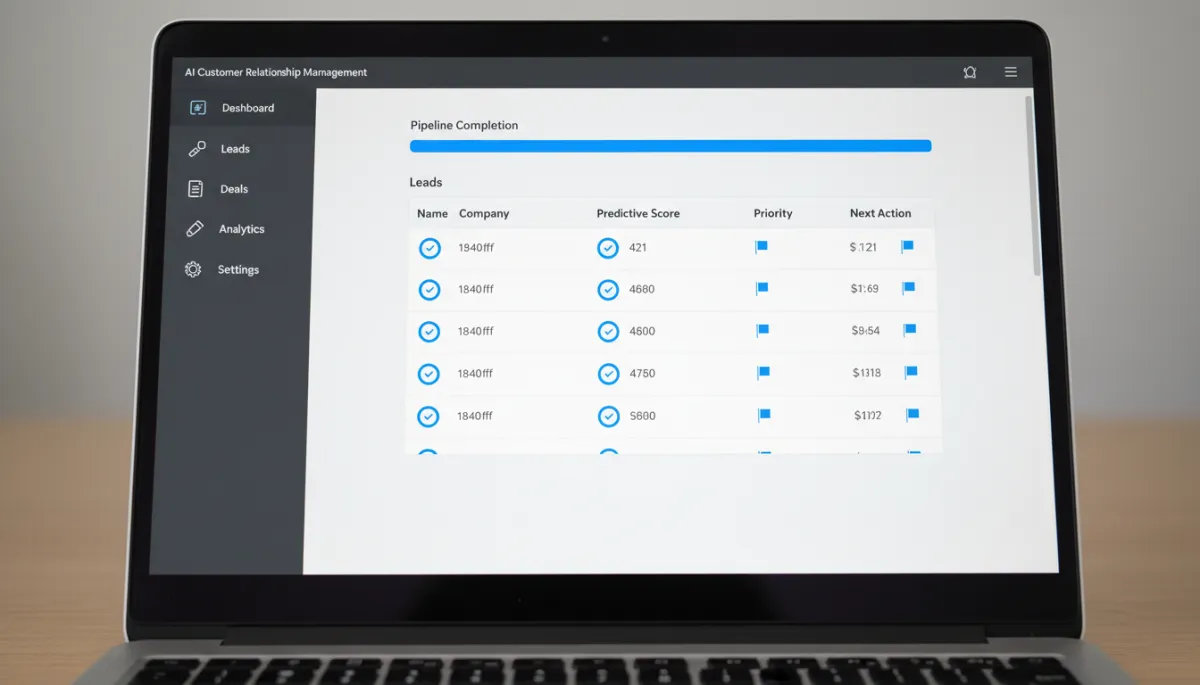
Clear lead queues help reps start each day with the highest-impact conversations.
Strengthening Sales Pipeline Management with AI Sales Tools
For operations heads and sales leaders, the real test of any technology is its impact on the pipeline. Modern AI sales tools go beyond individual lead scores to give you a more accurate, forward-looking view of revenue.
- Stage-by-stage conversion insights: Platforms like Salesforce Einstein, Zoho CRM with Zia, and Pipedrive analyse which scores and behaviours correlate with movement from one stage to the next. This helps you spot leaks early and redesign your process, rather than waiting for end-of-quarter surprises.
- Forecasting with confidence: When your pipeline is weighted by predictive conversion likelihood, your forecast becomes more than a gut feel. You can see, for example, that you have £500k in pipeline but only £220k in “AI-likely” deals, and adjust activity or targets accordingly.
- Channel and campaign optimisation: By combining predictive lead scoring with campaign data, you can identify which sources generate high-scoring, reachable leads — not just cheap clicks. This is critical when benchmark reports still show that up to 63% of supposedly “qualified” leads are unreachable or uninterested.
Choosing the Right AI CRM for Predictive Lead Scoring
The 2026 landscape of AI CRM platforms is crowded, but a few patterns are clear from independent reviews and rankings. Your choice should reflect your team size, complexity, and go-to-market model rather than the loudest vendor on social media.
- SMEs and growth-stage teams: HubSpot CRM, Freshsales, and Pipedrive consistently rank as “best for most businesses” because they combine intuitive interfaces with built-in predictive scoring and automation. They are ideal if you want to get started quickly without a heavy IT project.
- Mid-market and complex sales: Zoho CRM with Zia and Salesforce Einstein offer deeper customisation, broader ecosystems, and advanced AI. They suit teams with multiple product lines, territories, or long, multi-stakeholder deal cycles.
- Specialised models: Tools like MadKudu focus on product-led growth, while 6sense and Orbit AI excel at account-based and intent-driven scoring. These can be layered on top of an existing CRM when you have a clear, specialised need.

Align your AI CRM choice with team size, data maturity, and sales motion.
Implementing Predictive Lead Scoring in Your CRM This Week
Moving from theory to practice does not have to be a year-long digital transformation. Many SMEs can launch a first version of predictive lead scoring in days if they follow a structured approach.
- Define “good” and “bad” leads clearly. Look at the last 6–12 months of closed-won and closed-lost deals. Identify patterns in industry, company size, deal value, and engagement. This gives your AI model a grounded definition of success.
- Clean and enrich your CRM data. Standardise key fields, remove obvious junk, and enrich missing firmographic data. Consider using enrichment providers that can verify emails and phone numbers, as this directly impacts reachability and model accuracy.
- Switch on native AI scoring. In platforms like HubSpot, Zoho, Salesforce, and Freshsales, predictive lead scoring is often available as a built-in feature or add-on. Start with the default model; you can refine as you gather results.
- Align lead prioritisation rules. Define what happens when a lead crosses a certain score threshold: instant call, same-day follow-up, or entry into a specific sequence. Make these rules visible to the team so they trust and follow them.
- Combine AI with human verification. Research shows that adding a human verification step (such as a quick qualification call or manual review) can triple the conversion rate compared with behavioural scoring alone. Use AI to narrow the field, then let experienced reps validate fit.
- Monitor, learn, and iterate. Track outcomes by score band (for example, 80–100, 60–79, 40–59). If high-scoring leads are not converting, review your data inputs and definitions. Predictive models improve over time, but only if you feed them accurate feedback.
Bringing It All Together: A More Predictable, Profitable Sales Engine
For SME owners, sales managers, and operations leaders, the message is clear: treating every lead the same is no longer sustainable. Volumes are rising, expectations for rapid responses are increasing, and benchmark data shows that many teams still take hours or even days to follow up — leaving revenue on the table for faster competitors.
By adopting predictive lead scoring inside an AI CRM, you can turn raw enquiries into a prioritised, manageable flow of high-potential opportunities. Combined with strong sales pipeline management, automated nurturing, and carefully chosen AI sales tools, you create a sales engine that is faster, more focused, and far more predictable than manual methods or simple rules-based scoring.
If your website and CRM are not yet aligned with this kind of data-driven, AI-powered approach, you are likely leaving both leads and revenue untapped. The good news is that you can start improving this week — and you do not have to do it alone.
Get a Free SEO / Website Audit at nexurate.com/free-audit. Discover how your current digital presence supports (or holds back) effective lead generation and predictive scoring, and get practical recommendations tailored to your growth goals.
