
AI Lead Qualification for Real Estate Agents
Real Estate, AI Lead Generation, Lead Qualification
Real Estate Agents: How AI Lead Qualification Fills Your Pipeline on Autopilot
If you’re still relying on manual follow-up, scattered spreadsheets, and your own memory to manage leads, you’re leaving deals — and commissions — on the table. In 2026, AI lead generation for real estate is no longer a buzzword; it’s the difference between agents who are fully booked and those wondering where the next listing will come from.

Why Real Estate Lead Management Is Broken
A typical day for most agents looks like this: new leads drip in from portals, Facebook ads, your website, referrals, and sign calls. You glance at them between showings, promise yourself you’ll “follow up tonight,” and by the time you finally respond, the hottest buyers have already booked with another agent. Sound familiar?
The manual workflow most teams still use is fragile and full of failure points:
- Leads sit in your inbox or portal for hours before anyone replies — even though prospects contacted within 5 minutes are up to 21× more likely to qualify than those followed up after 30 minutes (ClaraSDR, 2026).
- You call once, maybe send a single text, then move on. There’s no structured, automated lead follow-up, so only the ultra-motivated buyers survive the process.
- Notes are scattered between your phone, WhatsApp, email threads, and a CRM for real estate agents that’s never fully updated — making it impossible to see true pipeline value or prioritize the right people today.
- Every lead is treated the same, whether they’re a cash buyer ready to write an offer this week or a casual renter “just browsing” for next year.
Across industries, businesses using AI for qualification see around a 67% increase in sales and 47% higher conversion rates compared to manual processes (StealthAgents, 2026). Yet in real estate, most agents still use AI only to write listing descriptions — not to do the one thing that actually grows GCI: qualify and convert leads.
Stage 1: Instant AI Engagement Within 60 Seconds
The first stage of AI lead generation for real estate is simple: every new lead gets a fast, human-like response — 24/7 — without you lifting a finger. Instead of waiting four hours like your competitors, your AI chatbot for real estate engages within 60 seconds or less, on any channel: website, portal, social ad, or QR code.
Here’s what that looks like in practice:
- Smart qualification questions: The AI asks the same questions a top ISA would: “Are you looking to buy, sell, rent, or invest?”, “What’s your ideal timeline?”, “Have you been pre-approved?”, “What price range are you comfortable with?”, “Are there any must-have neighborhoods or features?”
- Appointment booking on your calendar: Once the AI identifies a serious prospect, it offers available time slots synced to your calendar. The buyer or landlord books directly — no back-and-forth emails — and receives instant confirmation plus reminders by SMS or email.
- Automatic CRM tagging and notes: Every answer is pushed into your CRM for real estate agents and tagged appropriately: “Buyer – 0–3 months,” “Landlord – 2 units,” “Renter – corporate relocation,” and so on. You open the contact and immediately see the full conversation and context.
Instead of chasing every cold lead yourself, the AI chatbot for real estate does the first 5–10 minutes of discovery for you — consistently, instantly, and without burnout. You step into conversations only when there’s clear intent and a booked time in your diary.
Stage 2: Intelligent Lead Scoring and Routing That Prioritizes Closers
Once leads are engaged and captured, the next step is deciding who deserves your attention today. This is where AI-powered lead scoring goes far beyond a basic “hot, warm, cold” label. Modern systems analyse dozens of signals in real time and give every contact a living score that updates as they interact with your brand.
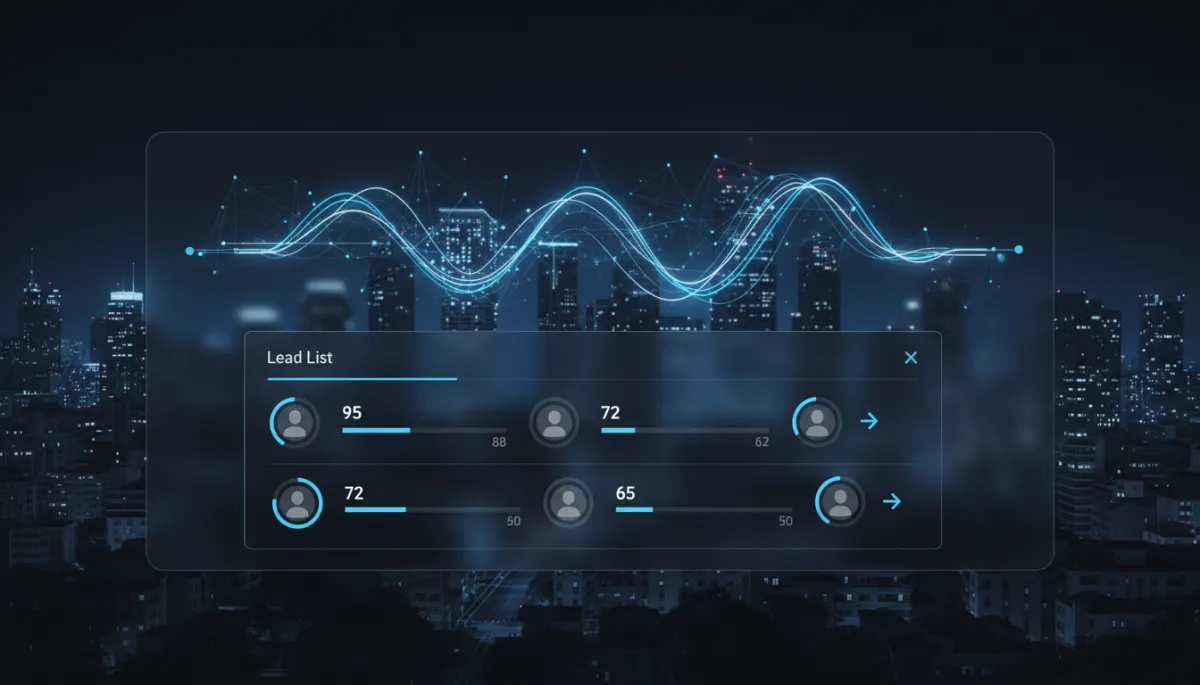
AI scoring surfaces ready-to-act buyers so agents focus where deals close fastest.
A robust AI lead qualification engine typically scores across four core dimensions:
- Timeline: Are they buying or selling in 0–3 months, 3–6 months, or “someday”? Shorter timelines automatically push them higher in your daily call list.
- Budget and financial readiness: Cash vs financed, pre-approved vs just starting, realistic price range vs fantasy browsing. This helps you avoid wasting time on leads who can’t transact in your market.
- Engagement level: How many listings have they viewed? Are they opening your emails, clicking on property recommendations, replying to texts, saving homes, or requesting more details?
- Responsiveness: How quickly do they reply to your AI assistant or to you? Are they answering detailed questions or giving one-word responses?
With these signals, the system can automatically route leads to the right person: high-score buyers to your top agents, investors to a specialist, and renters to your leasing team. Across industries, 61% of B2B teams already use AI for lead scoring (DigitalApplied, 2026), and the same logic maps perfectly to real estate — you simply swap “deal size” for “property value” and “contract term” for “buy/sell timeline.”
Stage 3: Automated 12-Week Nurture Sequences for Long-Term Buyers
Not every lead is ready this month — but many of your biggest commissions will come from the people who need 3–12 months before they can move. This is where most agents lose out: they stop following up after two or three attempts. AI flips that completely by running consistent, personalized nurture for you over weeks and months.
Here’s an example of a 12-week AI-driven email/SMS plan for a “3–6 month” buyer lead:
- Week 1: Welcome email with a quick summary of their criteria, plus an SMS checking if they’d like a curated list of properties. AI tracks every click and reply to refine their profile.
- Week 2: Educational email on financing options and pre-approval, followed by a short text asking if they’d like an introduction to a trusted lender.
- Week 3: Hyper-relevant listing digest based on their behavior so far — not generic MLS spam. The AI highlights 3–5 properties with a sentence on why each one fits.
- Week 4: Market update email focused on their target neighborhoods: price trends, days on market, and negotiation leverage. SMS asks: “Is your timeline still the same, or has anything changed?”
- Weeks 5–8: Alternating between value content (inspection tips, hidden costs, neighborhood spotlights) and behavior-triggered listing alerts. If they favorite a property, the AI immediately suggests a viewing and can book it on your calendar.
- Weeks 9–10: Deeper qualification: “Has anything shifted with your budget?”, “Are there any dealbreakers we haven’t discussed yet?” AI updates their score and can flag when they’re entering “ready to write” territory.
- Weeks 11–12: Stronger calls to action: curated “best opportunities this month,” plus a direct invite to a strategy call or open house tour, all framed around their exact situation and preferences.
Behind the scenes, AI continuously tests subject lines, send times, and messaging angles, learning what works best in your market. It doesn’t get bored, forget, or skip a week — and it feeds every interaction back into your CRM and lead scores.
Handling Landlord and Rental Leads Separately — Without Extra Work
Landlords and renters behave very differently from buyers and sellers — and your AI should treat them differently from the first interaction. One of the biggest advantages of AI lead generation for real estate is the ability to create separate flows by lead type, without managing multiple systems or lists manually.
- Landlord flows: The AI asks about number of units, current occupancy, rental income, pain points (vacancy, late payments, maintenance), and whether they’re open to selling in the next 12–24 months. It can then place them into a “management” nurture track or a “potential seller” track, with content focused on rent optimization, compliance, and long-term equity.
- Rental leads: For tenants, the chatbot focuses on move-in date, budget, employment status, pets, and preferred areas. It can automatically match them to available units, schedule viewings, and send reminders — while keeping them in a shorter nurture cycle, since rental decisions move fast.
On the backend, your CRM for real estate agents stays clean: landlords, renters, buyers, and sellers are all tagged and scored differently. That means when you want to run a landlord-only campaign or convert investors into sellers, you can do it in minutes — not days of list cleaning.
The Competitive Advantage That Compounds Over Time
In 2026, more than 80% of agents say they use AI somewhere in their workflow, but most limit it to content creation or basic chatbots. Only a minority are using AI as the engine behind their entire lead pipeline — from first click to closed deal. That gap is your opportunity.
When you respond to new leads in 15 minutes or less while competitors take four hours, your brand becomes synonymous with speed and professionalism. When your AI qualification layer runs 24/7, you never miss the insomniac buyer browsing portals at midnight, the overseas investor in a different time zone, or the landlord submitting a form between meetings. And because AI learns from every conversation, your targeting, messaging, and scoring get sharper every month.
- More qualified pipeline: Benchmarks show AI-driven funnels can generate 3.4× more qualified opportunities from the same traffic (GetPerspective, 2026) and up to 73% more sales-qualified leads overall (StealthAgents, 2026).
- Lower cost per deal: AI-assisted teams in other sectors have cut cost per meeting by 70%. In real estate, that translates into more closings per marketing dollar — and the ability to outspend competitors confidently where it matters.
- Time back for high-value work: With AI handling qualification, appointment setting, and nurture, you win back hours each week to negotiate, show, and close — the activities that actually grow your income.
Turn Your Website into a 24/7 AI Lead Engine
The future of AI lead generation real estate isn’t about adding yet another tool — it’s about turning your existing website and marketing into a fully automated, always-on qualification machine. From instant AI engagement and intelligent scoring to 12-week nurture sequences and landlord-specific flows, the technology is already here. The only question is whether your brand will be the one buyers, sellers, and landlords experience it with first.
If you want to see exactly where your current funnel is leaking leads — and how AI can plug those gaps — start with your foundation: your website, SEO, and lead capture strategy. Once those are aligned, AI can do its best work, filling your pipeline on autopilot while you focus on closing.
