AI Agents: 40% of Business Apps Autonomous by 2026
AI Strategy, Agentic AI for Business, Autonomous AI Workflows
From Chatbots to AI Agents: Why 40% of All Business Apps Will Be Autonomous by End of 2026
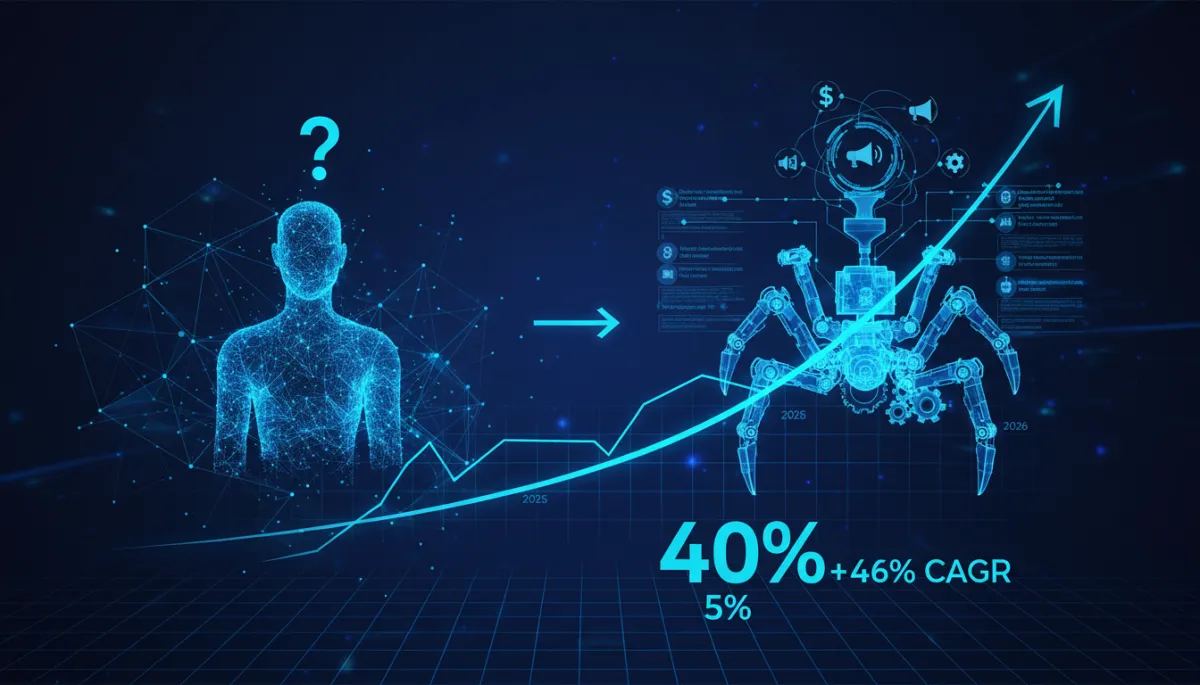
Agentic AI for business is moving from slide decks to balance sheets. By the end of 2026, Gartner expects 40% of enterprise applications to embed task-specific AI agents, up from less than 5% in 2025, driven by a 46%+ compound annual growth rate in agent software spend. For CEOs, founders and SME owners, the question is no longer whether to adopt autonomous AI workflows, but how fast you can do it without breaking your business.

1. Chatbots vs True AI Agents: Reactive vs Autonomous
Most leaders have already experimented with chatbots. They sit on your website, answer FAQs, maybe route a ticket. Technically, they are reactive systems: they wait for a user message, generate a response, and stop. No memory, no planning, no independent action. They are a smarter IVR menu, not a digital employee.
Agentic AI is a different category. A true AI agent is designed to pursue goals, not just answer prompts. It can:
- Maintain state and memory across steps and days, not just one message
- Plan multi-step workflows to reach an outcome (e.g., “qualify this lead and book a meeting”)
- Act on external systems via APIs, CRMs, ERPs, email and ticketing tools
- Self-correct by inspecting results and trying alternative strategies
As a senior engineer, I describe it this way to boards: a chatbot is a conversation feature. An AI agent is a delegated team member with access to your systems and a clear KPI. That is the level of autonomy Gartner is tracking when they talk about agentic AI for business.
2. The 2026 Agentic AI Surge: 40% of Apps Will Embed Agents
Gartner forecasts that by the end of 2026, around 40% of enterprise applications will embed task-specific AI agents, up from less than 5% in 2025. That is not a marketing slogan; it is a structural shift in how software behaves inside your business. Agent software spend alone is projected to more than double from $86.4 billion in 2025 to $206.5 billion in 2026, with a 46%+ CAGR continuing into 2027 and beyond.
In parallel, global AI spending is expected to reach $2.59 trillion in 2026, with a major share going into infrastructure that enables autonomous AI workflows. By 2028, Gartner expects AI agent ecosystems to mediate up to 90% of B2B transactions, pushing over $15 trillion through AI-driven exchanges. The window to treat this as a “wait and see” experiment is closing rapidly.
3. What Agentic AI Actually Does for Business
In practical terms, agentic AI for business is about owning outcomes, not tasks. Instead of telling software “send this email” or “create this invoice”, you assign a goal such as “collect payment on this invoice within 7 days” and the agent orchestrates the steps across systems.
- Planning multi-step workflows. Agents break a goal into steps: gather data, choose a strategy, execute actions, monitor results, and iterate. This can span multiple days and touch multiple tools.
- Making decisions with constraints. You specify policies (“do not discount more than 15%”, “do not email a contact more than twice per week”). The agent chooses the best action that respects those rules.
- Coordinating across systems. Modern agents call APIs, write to databases, create tickets, and update CRMs. They are the glue between siloed SaaS tools, effectively turning your stack into a multi-agent system.
At implementation level, an agent is usually a loop that reads context, decides what to do next, calls tools, and then evaluates the result. A simplified Python-style sketch looks like this:
def sales_qualification_agent(lead_id: str, goal: str = "qualify_and_book"):
    context = load_lead_context(lead_id)
    history = []

    while not goal_reached(context, goal) and not timeout_reached():
        # 1. Ask the model what to do next
        plan = llm_plan(
            objective=goal,
            context=context,
            history=history,
            tools=list_available_tools()
        )

        # 2. Execute the suggested tool
        tool_name = plan["tool"]
        tool_args = plan["args"]
        result = execute_tool(tool_name, **tool_args)

        # 3. Update context and history
        context = update_context(context, result)
        history.append({"plan": plan, "result": result})

        # 4. Optional: escalate if risk or ambiguity is high
        if requires_human_review(result):
            notify_human_owner(lead_id, result)
            break

    return summarize_outcome(context)
This is the core difference from a chatbot: the loop continues until the goal is reached or a guardrail is triggered, not until the conversation ends.
4. Real-World Use Cases You Can Deploy Today

Dark electric blue tech dashboard showing multiple AI agents handling sales, support, finance...
Sales Qualification Agents
A sales qualification agent connects to your website forms, CRM and calendar. When a new lead arrives, it:
- Enriches the lead from public data (LinkedIn, company websites, firmographics)
- Scores the lead against your ICP and playbooks
- Sends a tailored response email, then follows up if there is no reply
- Books meetings directly into reps’ calendars when criteria are met
Instead of SDRs burning hours on low-intent leads, the agent handles initial triage and scheduling. Humans focus on closing, not chasing.
Customer Support Agents
Support agents go beyond answering FAQs. They can read your knowledge base, access order data, issue refunds (within policy), and update tickets. A typical autonomous workflow:
- Understand the customer’s intent and sentiment from chat or email
- Retrieve order or account details via APIs
- Decide whether to refund, replace, escalate or educate based on rules
- Execute the action and close the loop with the customer
Finance and Collections Agents
Finance agents monitor invoices, payment terms and bank feeds. They can:
- Identify overdue invoices and segment customers by risk and value
- Send personalised reminders, switching tone and channel based on history
- Propose payment plans within guardrails, escalating only complex cases
Marketing Automation Agents
Marketing agents continuously run experiments. They generate variants of copy, adjust budgets, and shift spend between channels based on live performance, rather than waiting for monthly reviews. In multi-agent systems, one agent may focus on creative testing while another optimises bidding strategies, both aligned to a shared ROAS target.
5. How SMEs Can Start Building Their First AI Agent Today
You do not need a research lab to benefit from agentic AI. You need one well-chosen process and a disciplined rollout. A practical starting playbook:
- Pick a single, narrow process. Examples: inbound lead qualification, first-line support for one product, invoice reminders for small accounts. The goal is to prove value fast, not to automate the entire company on day one.
- Define the agent’s objective and guardrails. For example: “Book qualified meetings for the sales team” with constraints on tone, frequency, discounts and escalation rules.
- Connect 2–3 core tools. Typically your CRM, email platform and calendar. Use APIs or integration platforms; many now support agentic AI for business out of the box.
- Start in “copilot” mode. Let the agent draft actions (emails, ticket updates, responses) while humans approve. Measure quality and speed, then gradually increase autonomy where performance is strong.
- Instrument and monitor. Track KPIs like response time, conversion rate, CSAT and error rate. Treat the agent as you would a new hire: review its performance, retrain where needed, and give it clearer playbooks over time.
Technically, many SMEs can implement an initial agent using existing SaaS plus light scripting. For example, a simple orchestrator that reacts to CRM events:
def on_new_lead(lead):
    # 1. Ask the LLM to classify and score
    analysis = llm_analyse_lead(
        name=lead.name,
        company=lead.company,
        message=lead.message
    )

    # 2. Decide next action
    if analysis["score"] < 0.5:
        tag_lead(lead.id, "low_priority")
        return

    # 3. Draft outreach email
    email = llm_generate_email(
        template="qualification",
        lead=lead,
        insights=analysis["insights"]
    )

    # 4. Send via email provider and log in CRM
    send_email(lead.email, email["subject"], email["body"])
    create_activity(lead.id, "Agent sent qualification email")
This is not science fiction. It is a realistic first step for AI agents SME teams can manage with modest engineering support.
6. Why Waiting Is the Wrong Strategy
Some leaders are understandably cautious. Agentic AI comes with governance, security and cultural challenges. Gartner also warns that more than 40% of agentic AI projects may be cancelled by 2027 due to poor scoping and weak risk controls. But the answer is not to wait; it is to start small and learn fast.
- If 40% of enterprise apps embed agents by 2026, your staff will increasingly work inside ecosystems where AI is the default operator. Teams without hands-on experience will be at a structural disadvantage.
- Productivity gaps compound. If competitors automate 20–30% of operational workload with autonomous AI workflows, they can reinvest savings in growth, pricing or customer experience while you are still debating pilots.
- Governance skills take time to build. You will need policies for data access, audit trails, human override and error handling. Those capabilities only mature through real-world use.
Next Step: Audit Your Digital Front Door Before You Add Agents
Every effective AI agent strategy starts with a clear view of your current digital assets: your website, SEO footprint, analytics, and conversion flows. Agents amplify what already exists. If your funnels are leaky or your content is misaligned, you will simply automate inefficiency.
Before you deploy your first agent, ensure your site is discoverable, your messaging is clear, and your data flows are intact. Then you can confidently layer agentic AI for business on top to qualify leads, respond to visitors and orchestrate follow-up with measurable ROI.
If you want a practical, low-risk way to begin, start by understanding where your current digital experience helps or hinders autonomous AI workflows.
